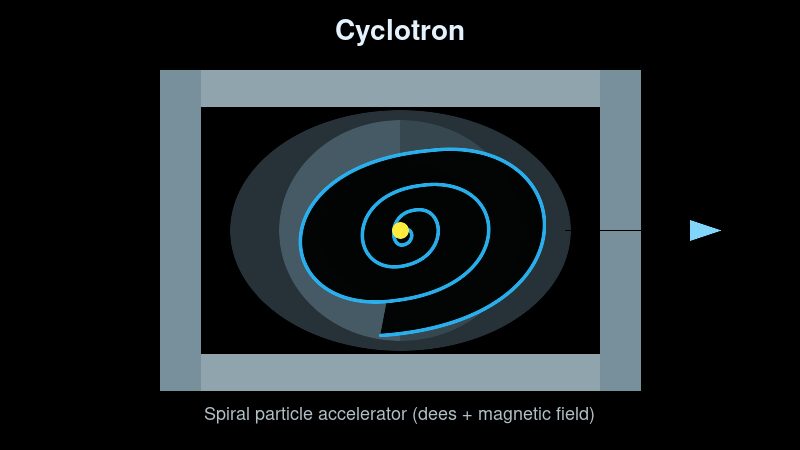
A cyclotron is a type of particle accelerator that speeds up charged atomic or subatomic particles (such as protons or ions) inside a constant magnetic field. Particles start near the center between two hollow, D-shaped electrodes called “dees”; an alternating electric field kicks them each time they cross the gap, while the magnet bends their path into a widening spiral.
Invented by Ernest O. Lawrence (with M. Stanley Livingston) in the early 1930s, cyclotrons are still widely used to produce medical radioisotopes for imaging such as PET scans and for some particle beam therapies. Classical designs are limited by relativity as particles near the speed of light; modern isochronous and synchrocyclotrons extend that range.