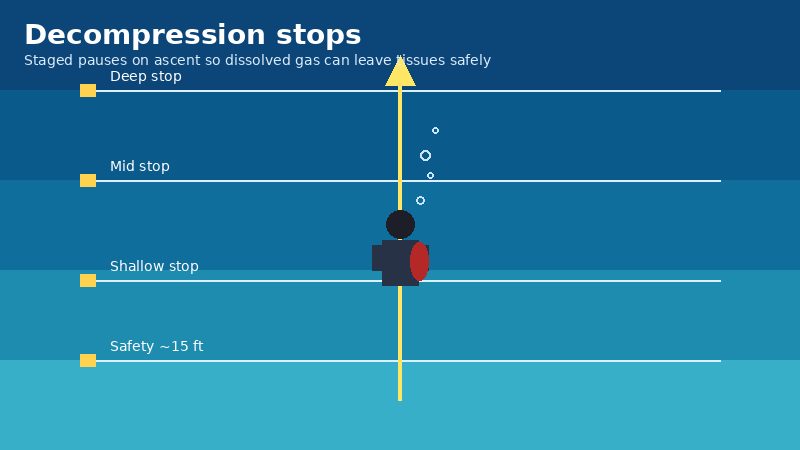
Decompression stops are planned pauses at specific depths during a diver’s ascent. They give the body time to release inert gases—mainly nitrogen, and sometimes helium on mixed-gas dives—that dissolved into tissues under higher pressure at depth.
If a dive exceeds its no-stop (no-decompression) limit, ascending straight to the surface raises the risk of decompression sickness (“the bends”). Staged stops at progressively shallower depths reduce that risk. NOAA Ocean Exploration notes that technical diving systems require such stops before returning to the surface, with stop depth and duration depending on time spent at depth.
Recreational “safety stops” (often about three minutes near 15 feet / 5 meters) are related but usually optional precautions within no-stop limits; required decompression stops are mandatory when the dive profile demands them.