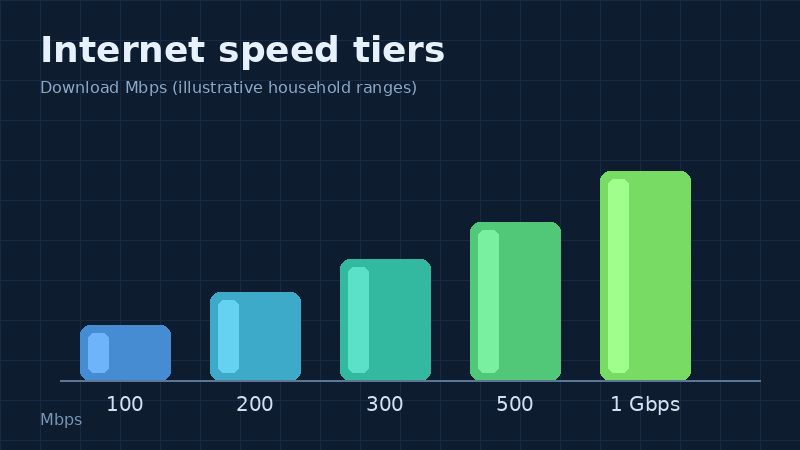
Internet speeds are usually sold and compared as download megabits per second (Mbps). Higher tiers support more devices at once and heavier tasks such as HD streaming, video calls, gaming, and large downloads.
In the United States, the Federal Communications Commission’s current broadband benchmark is at least 100 Mbps download and 20 Mbps upload. Practical household guides often treat about 200–300 Mbps as a solid midrange for a few users who stream or work from home, while 500 Mbps to 1 Gbps (1,000 Mbps) better fits heavy multi-device homes.
Download speed is how fast data reaches you; upload speed is how fast you send data out. Streaming leans on download, while video calls, live uploads, and cloud backups need stronger upload.