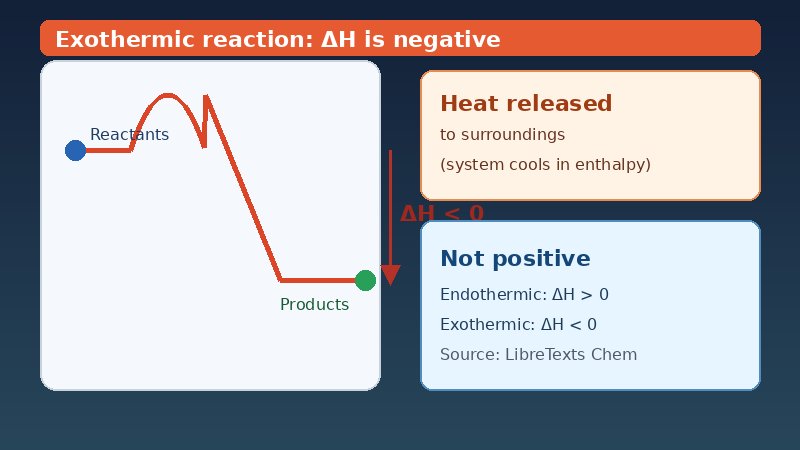
No. In thermochemistry, an exothermic reaction has a negative enthalpy change (ΔH < 0): heat flows from the system to the surroundings, so the products have lower enthalpy than the reactants. Reactions with a positive ΔH are endothermic—they absorb heat from the surroundings.
A common classroom example is methane combustion, which releases about 890.4 kJ of heat per mole and is written with ΔH = −890.4 kJ. People sometimes say an exothermic process is “positive” because the surroundings feel warmer, but the signed enthalpy change for the reaction system itself is negative.
Source: 7.3: Exothermic and Endothermic Reactions — Chemistry LibreTexts.