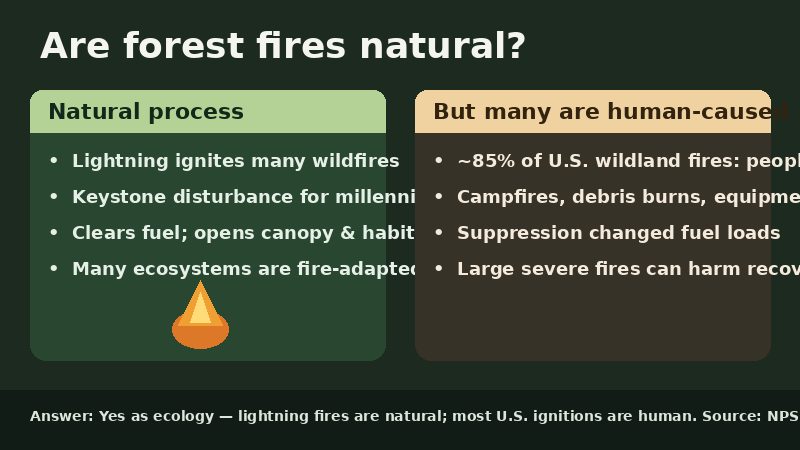
Yes — in many ecosystems, forest (wildland) fire is a natural ecological process. The U.S. National Park Service notes that wildland fires are an essential part of the natural cycle: lightning ignites fires in a recurring pattern, and forests and grasslands in places such as the Northern Rockies are adapted to that disturbance. Fire can clear vegetation and fuel, open the canopy, release nutrients, and create a mosaic of burned and unburned patches that supports diverse plant and animal habitat.
That does not mean every wildfire is a natural ignition. NPS also reports that nearly 85% of wildland fires in the United States are caused by people (for example unattended campfires, debris burning, equipment, or arson), while lightning is a primary natural cause. Fire ecology and history also vary by region and forest type.
Source: Wildland Fire Ecology Resource Brief — U.S. National Park Service