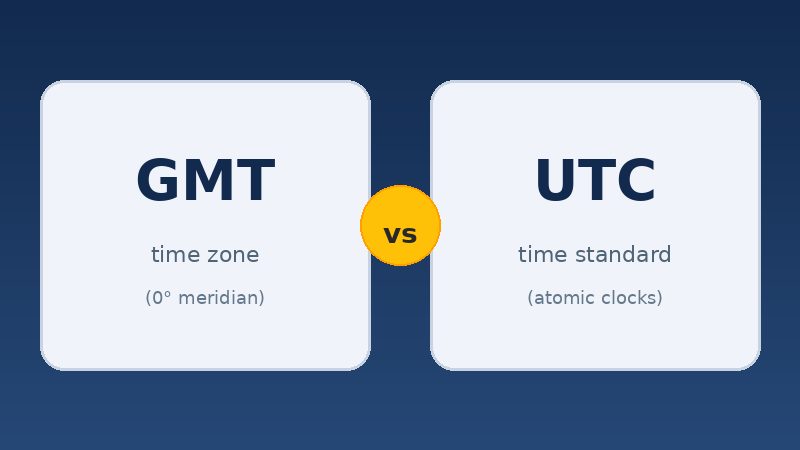
GMT (Greenwich Mean Time) originally meant mean solar time at the Royal Observatory in Greenwich, England; today the term is also commonly used for the civil time zone at the prime meridian (UTC+0). UTC (Coordinated Universal Time) is the international atomic time standard used as the reference for civil time worldwide. UTC is based on International Atomic Time (TAI) and is kept within less than one second of Earth’s rotation (UT1) by leap seconds.
For everyday clock reading they match: clocks labeled GMT and UTC show the same time. The practical distinction is that UTC is the official global reference derived from atomic clocks, while GMT is a time-zone label (and historically an astronomical timescale). NIST notes that when fractions of a second do not matter, GMT and UTC can be treated as equivalent.