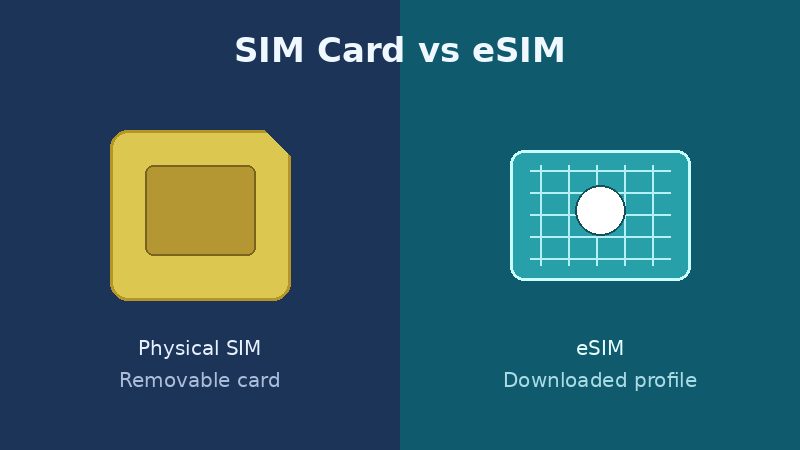
A traditional SIM card (Subscriber Identity Module) is a removable secure element that stores the credentials a phone needs to authenticate onto a mobile network, and it can be moved between compatible devices. An eSIM serves the same authentication role, but under the GSMA’s remote SIM provisioning standards the operator profile is securely downloaded into a secure element that can be permanently embedded in the device—so there is no physical card to insert or swap.
For consumers, eSIM typically lets a device store multiple operator profiles and switch between them remotely (usually with one active at a time), while a physical SIM is swapped by hand. GSMA states that eSIM offers an equivalent level of security and protection to a removable SIM card; the practical difference is physical removability versus over-the-air provisioning.
Source: What is an eSIM? — GSMA