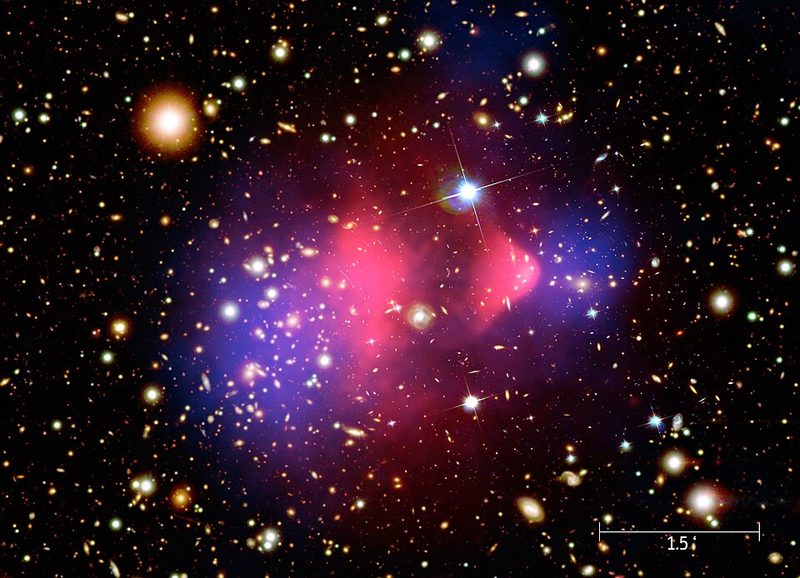
Scientists have not yet detected dark matter directly; they know it is there because of its gravity. According to the U.S. Department of Energy, the gravity measured in the rotation of stars in galaxies, the motion of galaxies in clusters, and the large-scale structure of the universe is about five times more than ordinary matter can explain. This was first noticed by Fritz Zwicky in the Coma Cluster in 1933 and strengthened by Vera Rubin’s galaxy-rotation studies in the 1970s.
To find out what dark matter actually is, researchers use three main approaches. Direct detection uses large, sensitive detectors placed deep underground to catch the rare collision of a dark matter particle passing through Earth. Indirect detection uses ground- and space-based observatories to look for telltale signatures in cosmic rays and gamma rays. Particle accelerators such as the Large Hadron Collider try to create dark matter particles, which would show up as energy missing after a collision. Leading candidates include WIMPs (weakly interacting massive particles) and axions.
Source: U.S. Department of Energy, DOE Explains: Dark Matter.
Image: Bullet Cluster (1E 0657-56) composite, where blue shows mass mapped by gravitational lensing and pink shows hot gas; NASA/CXC, public domain, via Wikimedia Commons.