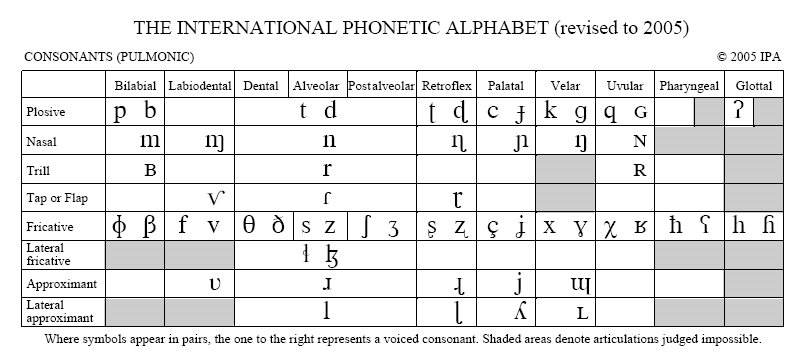
Phonetic symbols are written characters that each stand for one specific speech sound, so that pronunciation can be recorded the same way for any language. For example, the English word “ship” is written /ʃɪp/, with ʃ standing for the “sh” sound.
The standard set is the International Phonetic Alphabet (IPA), maintained by the International Phonetic Association. The association was founded in Paris in 1886 and describes the alphabet as a notational standard for the phonetic representation of all languages. Its official IPA chart groups the symbols into consonants, vowels, diacritics, suprasegmentals (such as stress and length), and tones. Only changes approved by the association’s Council count as part of the official IPA. The chart’s content was last revised in 2015/2005, and since 2025 it has been reissued each year with an updated copyright date.
Source: International Phonetic Association, “The International Phonetic Alphabet and the IPA Chart”
Image: IPA Pulmonic.gif (pulmonic consonants section of the IPA chart), International Phonetic Association, CC BY-SA 3.0, via Wikimedia Commons.