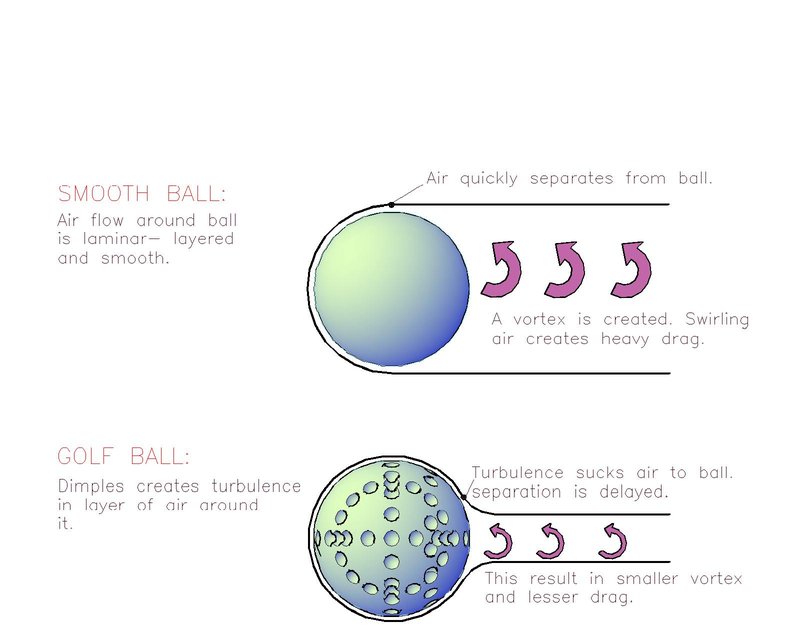
There is no single fixed number: manufacturers choose dimple counts by model, and the U.S. Golf Association does not require a specific count on conforming balls. According to aerodynamic researchers writing for Scientific American, most golf balls have between 300 and 500 dimples, typically about 0.010 inch deep. Those dimples create a thin turbulent boundary layer that reduces drag so a spun ball can travel roughly twice as far as a smooth one.
Counts outside that band exist, but 300–500 is the practical range for modern balls; common models often land near the lower half of that span. Dimple size, depth, and pattern matter as much as the raw total for trajectory and distance.
Source: Scientific American, “How do dimples in golf balls affect their flight?”.
Image: Golf ball dimples, by Prakul varshney. CC BY-SA 4.0, via Wikimedia Commons.