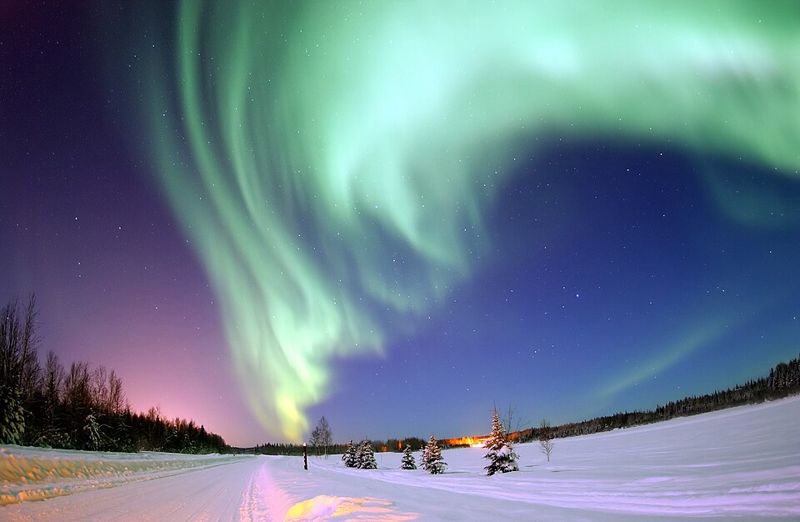
The northern lights (aurora borealis) are caused by energetic electrons from Earth’s magnetosphere, ultimately powered by the solar wind, streaming down along Earth’s magnetic field lines toward the polar regions and colliding with oxygen and nitrogen in the upper atmosphere. The collisions excite those atoms and molecules, and when they drop back to lower energy states they release the energy as light, much like a neon sign.
The glow typically forms 80 to 500 km (about 50 to 310 miles) above the surface, in two oval-shaped zones centered on the magnetic poles, so it is seen most often between roughly 60 and 75 degrees latitude. During strong geomagnetic storms the ovals expand toward the equator, which is when the aurora can be seen over much of the United States and Europe (NOAA Space Weather Prediction Center).
Source: NOAA Space Weather Prediction Center: Aurora
Image: Aurora borealis over Eielson Air Force Base, Alaska, U.S. Air Force photo by Senior Airman Joshua Strang, public domain, via Wikimedia Commons.