They are ripples in the air, not in the ocean or in spacetime. In a strong hurricane, heat released near the eyewall drives powerful updrafts that build towering thunderstorm clouds, and those updrafts jolt the surrounding atmosphere. The disturbance travels upward and outward as waves, with gravity acting as the restoring force that pulls displaced air back down, and the waves can reach the stratosphere and mesosphere.
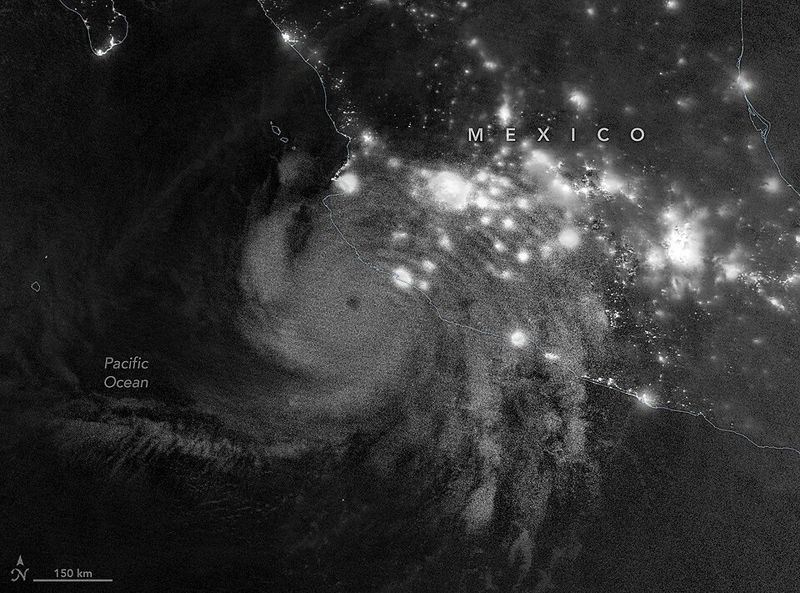
Satellites can sometimes see them because they pass through airglow, a faint natural light emitted by gases high in the atmosphere, creating concentric bands of brighter and dimmer light. NASA reported that the VIIRS instrument on NOAA-21 captured these rings spreading out from Category 4 Hurricane Simon off Mexico’s Pacific coast early on October 11, 2026, when very little moonlight made the faint glow easier to detect. Strong high-altitude winds often break up such waves before they get that high, so clear views are uncommon.
Image: Nighttime view of Hurricane Simon off the Mexican coast, October 11, 2026. NASA Earth Observatory image by Michala Garrison using VIIRS data, public domain, via Wikimedia Commons.