It depends on the plastic, but in a new University of Konstanz study several biodegradable plastics broke down completely in forest soil in roughly 250 to 330 days, or about nine to eleven months. The materials tested were long-chain aliphatic polyesters (LCAP) along with the bioplastics PHBV and PCL. For comparison, plain cellulose broke down in about 80 days, while conventional high-density polyethylene (HDPE) showed virtually no degradation over the same year.
The researchers also found tiny bacteria-sized holes in films buried about 10 centimeters deep, and identified a so-called “Pac-Man” enzyme with an unusually wide active site that digests certain polyesters and can also break down penicillin. The results were published in The ISME Journal. The key point is that only plastics whose chemical bonds microbes can attack break down this way; most conventional plastics do not.
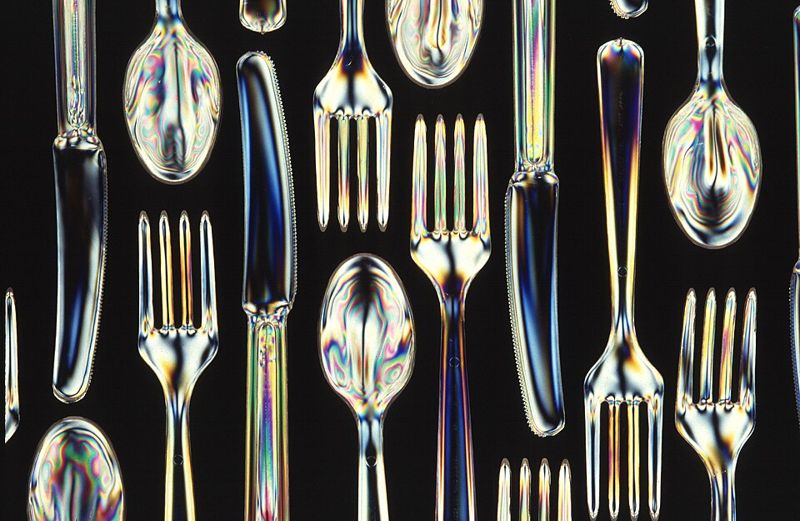
Image: Knives, forks, and spoons made from a biodegradable starch-polyester material. Photo by Scott Bauer, USDA Agricultural Research Service, public domain, via Wikimedia Commons.