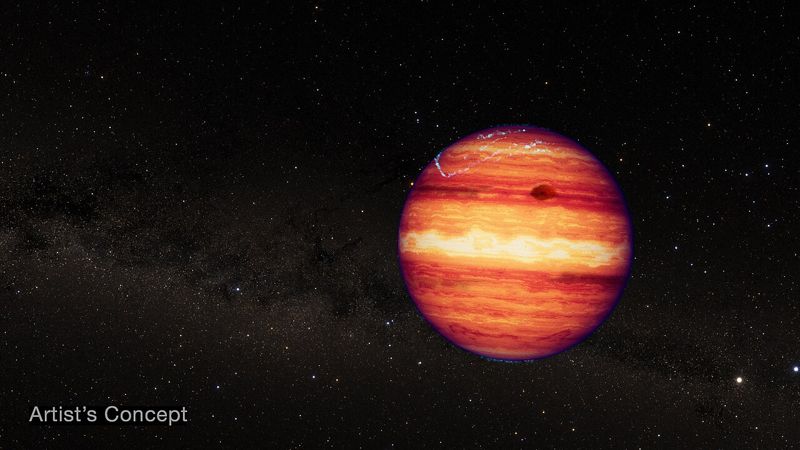
A Trinity College Dublin team analyzing James Webb Space Telescope data on SIMP 0136, a brown dwarf about 20 light-years from Earth, found that nearly all of its seemingly chaotic atmospheric variability can be explained by just two factors: temperature changes and the vertical structure of its clouds. Using principal component analysis on how the object’s light changed as it rotated, they identified three recurring weather states that rotate in and out of view, with some regions hotter with thinner clouds and others cooler with thicker, taller cloud layers.
These weather drivers persisted across more than a dozen rotations even as the detailed appearance of the atmosphere changed. The researchers say the method offers a fast first step for studying weather on other brown dwarfs and giant exoplanets before running more intensive computer models.
Source: “NASA’s Webb reveals the wild weather of a mysterious world 20 light-years away,” ScienceDaily, from materials provided by Trinity College Dublin (October 17, 2026); study: Schrader et al., “The JWST weather report: Unravelling the atmospheric variability of isolated worlds using principal component analysis,” Astronomy & Astrophysics 713, A192 (2026), DOI 10.1051/0004-6361/202660109.
Image: Artist’s concept of SIMP 0136. NASA, ESA, CSA, J. Olmsted (STScI), CC BY 4.0, via Wikimedia Commons.