
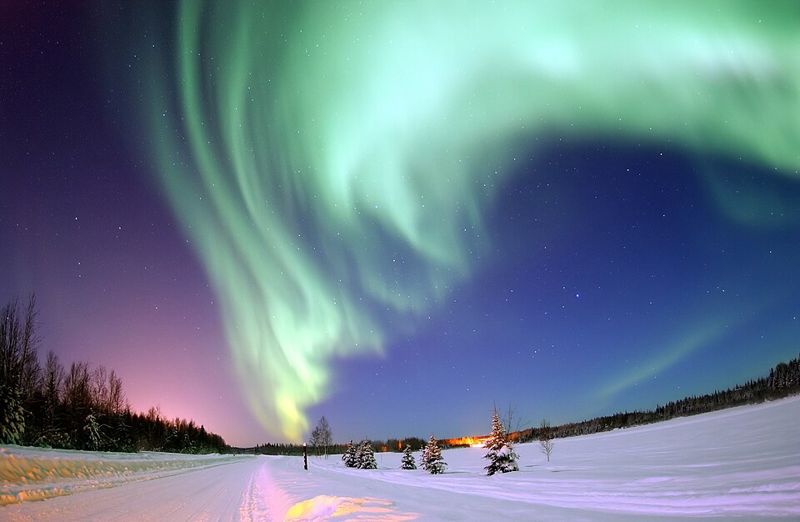
The Kp index (planetary K index) is a 0-to-9 scale that measures how disturbed Earth’s magnetic field is, and aurora watchers use it as a quick guide to how bright and how far from the poles the northern or southern lights are likely to reach. NOAA’s Space Weather Prediction Center estimates Kp for each three-hour period from a network of ground-based magnetometers in North America, Europe, and Australia. At Kp 0 to 2 the aurora stays far north and dim, at Kp 3 to 5 it becomes brighter and moves farther from the poles, at Kp 6 to 7 it may be visible from the northern edge of the United States, and at Kp 8 to 9 it can appear overhead in the northern U.S. states.
SWPC says the auroral oval’s equatorward edge sits near 66 degrees magnetic latitude at Kp 0 and moves about 2 degrees closer to the equator for each Kp step, reaching about 48 degrees at Kp 9. A reading of Kp 5 or higher counts as a geomagnetic storm on NOAA’s G scale, starting at G1 (minor). These are averages, so darkness, clear skies, and distance from city lights still matter.
Source: NOAA Space Weather Prediction Center, Tips on Viewing the Aurora; see also NOAA SWPC, Planetary K-index
Image: Aurora borealis over Eielson Air Force Base, Alaska, U.S. Air Force photo by Senior Airman Joshua Strang, public domain, via Wikimedia Commons.
Related answers
- What are index fossils, and why are they important?
- Is Oumuamua still debated among top scientists?
- What are the winter 2026/2027 snowfall predictions?