
Last updated: October 25, 2026
To convert Celsius to Fahrenheit, multiply the Celsius temperature by 1.8 and add 32: °F = (°C × 1.8) + 32. For example, 20°C is 68°F, 30°C is 86°F and 100°C is 212°F. The formula is exact, and 1.8 is the same as the fraction 9/5.
This guide gives the formula, a step-by-step example, a Celsius to Fahrenheit chart for everyday temperatures, oven conversions, and a mental shortcut you can use without a calculator.
Contents
- Celsius to Fahrenheit formula
- How to convert Celsius to Fahrenheit step by step
- Celsius to Fahrenheit conversion chart
- How to convert Celsius to Fahrenheit in your head
- Celsius to Fahrenheit for oven temperatures
- Fahrenheit to Celsius and Celsius to Kelvin
- Why the two scales differ
- Frequently asked questions
Celsius to Fahrenheit formula
The National Institute of Standards and Technology gives the exact conversion as °F = (°C × 1.8) + 32 (NIST SI Units: Temperature). The National Weather Service writes the same formula with a fraction: °F = (9/5 × °C) + 32 (NWS temperature conversion sheet).
Two numbers do all the work. The 1.8 accounts for the size of each degree: NIST notes that an interval of one Celsius degree equals 1.8 Fahrenheit degrees. The 32 accounts for the different starting points, because water freezes at 0°C but at 32°F.
How to convert Celsius to Fahrenheit step by step
- Write down the temperature in degrees Celsius, for example 25°C.
- Multiply it by 1.8 (or by 9, then divide by 5): 25 × 1.8 = 45.
- Add 32 to the result: 45 + 32 = 77.
- The answer is in degrees Fahrenheit: 25°C = 77°F.
Negative numbers work the same way. For −10°C, multiply first (−10 × 1.8 = −18), then add 32 to get 14°F. Always multiply before adding; adding 32 first gives the wrong answer.
Celsius to Fahrenheit conversion chart
Each value below was calculated with the exact formula and rounded to one decimal place where needed. Descriptions in the right column come from the approximate touchstone temperatures NIST publishes.
| Celsius (°C) | Fahrenheit (°F) | Reference point |
|---|---|---|
| −40°C | −40°F | Celsius and Fahrenheit are equal |
| −30°C | −22°F | |
| −20°C | −4°F | |
| −10°C | 14°F | |
| −5°C | 23°F | |
| 0°C | 32°F | Water freezes (NIST) |
| 5°C | 41°F | |
| 10°C | 50°F | Cold day (NIST) |
| 15°C | 59°F | |
| 20°C | 68°F | Room temperature (NIST) |
| 25°C | 77°F | |
| 30°C | 86°F | Hot day (NIST) |
| 35°C | 95°F | |
| 37°C | 98.6°F | Body temperature, approximate (NIST) |
| 40°C | 104°F | Sweltering day (NIST) |
| 50°C | 122°F | |
| 60°C | 140°F | |
| 70°C | 158°F | |
| 80°C | 176°F | |
| 90°C | 194°F | |
| 100°C | 212°F | Water boils at sea level, about (NIST) |
Weather forecasts in the United States use Fahrenheit, so the chart is handy for reading thresholds such as a hard freeze, which the Weather Service sets at 28°F, or about −2°C.
How to convert Celsius to Fahrenheit in your head
The common shortcut is to double the Celsius number and add 30. It works because 2 is close to 1.8 and 30 is close to 32. The estimate is good for everyday weather but drifts as temperatures rise.
| Celsius | Double and add 30 | Exact Fahrenheit | Difference |
|---|---|---|---|
| 0°C | 30°F | 32°F | −2°F |
| 10°C | 50°F | 50°F | 0°F |
| 15°C | 60°F | 59°F | 1°F |
| 20°C | 70°F | 68°F | 2°F |
| 25°C | 80°F | 77°F | 3°F |
| 30°C | 90°F | 86°F | 4°F |
| 40°C | 110°F | 104°F | 6°F |
The shortcut is exact at 10°C and stays within 2 degrees between 0°C and 20°C. Above that, it overestimates. For a closer mental answer, double the number, subtract 10 percent of that result, then add 32. For 30°C: 60, minus 6, is 54, plus 32 gives the exact 86°F.
Celsius to Fahrenheit for oven temperatures
Recipes from outside the United States usually list oven settings in Celsius. NIST publishes these approximate equivalents for traditional oven terms (NIST oven temperature equivalences):
| Oven description | °F | °C |
|---|---|---|
| Very slow | 250 | 120 |
| Slow | 300 to 325 | 150 to 160 |
| Moderately slow | 325 to 350 | 160 to 180 |
| Moderate | 350 to 375 | 180 to 190 |
| Moderately hot | 375 to 400 | 190 to 200 |
| Hot | 400 to 450 | 200 to 230 |
| Very hot | 450 to 500 | 230 to 260 |
Oven dials are marked in round numbers, so recipes round as well. A recipe calling for 180°C is usually set at 350°F, even though the exact figure is 356°F. For roasting, the doneness temperature matters more than the oven setting; see our guide on how long to cook a turkey, where the safe internal temperature is 165°F (74°C). For other kitchen conversions, see how many ounces are in a cup and how many teaspoons are in a tablespoon.
Fahrenheit to Celsius and Celsius to Kelvin
To go the other way, reverse the steps: subtract 32, then divide by 1.8. NIST writes it as °C = (°F − 32) / 1.8. So 50°F minus 32 is 18, and 18 ÷ 1.8 is 10°C.
Scientists often use the kelvin, the SI unit of temperature. Converting is simple: K = °C + 273.15, so 0°C is 273.15 K. NIST notes that one kelvin is the same size as one Celsius degree, and 0 K is called absolute zero. To go straight from kelvin to Fahrenheit, use °F = (K − 273.15) × 1.8 + 32.
If you need a quick check, the National Weather Service also offers an online temperature conversion calculator. For a practical case involving very low temperatures, see how long dry ice lasts in a cooler.
Why the two scales differ
The Fahrenheit scale sets the freezing point of water at 32° and the boiling point at 212°, with 180 equal degrees between them. The Celsius scale divides the same span into 100 degrees, from 0° to 100°. That 180-to-100 ratio is where the factor 1.8 comes from.
According to Encyclopaedia Britannica, the 18th-century physicist Daniel Gabriel Fahrenheit originally set zero at the temperature of an ice and salt mixture. Fahrenheit is used in the United States, while Celsius is used in most other countries and for scientific work worldwide.
Frequently asked questions
What is the formula to convert Celsius to Fahrenheit?
Multiply the Celsius temperature by 1.8 (or 9/5) and add 32. For example, 25°C × 1.8 = 45, and 45 + 32 = 77°F.
What is the easiest way to convert Celsius to Fahrenheit?
For a quick estimate, double the Celsius number and add 30. It is close for everyday weather, such as 15°C, which gives 60°F against an exact 59°F, but use the exact formula for cooking, medicine or science.
What is 37 C in Fahrenheit?
37°C equals 98.6°F, because 37 × 1.8 = 66.6 and 66.6 + 32 = 98.6. NIST lists 37°C as an approximate human body temperature.
Is 20 degrees Celsius hot or cold?
20°C equals 68°F, which NIST describes as room temperature. Most people find it mild or comfortable.
At what temperature are Celsius and Fahrenheit equal?
The two scales meet at −40. Minus 40 degrees Celsius is exactly minus 40 degrees Fahrenheit.
How do you convert Fahrenheit to Celsius?
Subtract 32 from the Fahrenheit temperature, then divide by 1.8 (or multiply by 5/9). For example, 212°F minus 32 is 180, and 180 ÷ 1.8 = 100°C.
Sources
- NIST: SI Units, Temperature
- National Weather Service: Temperature Conversion (PDF)
- National Weather Service: Temperature Conversion Calculator
- Encyclopaedia Britannica: Fahrenheit temperature scale
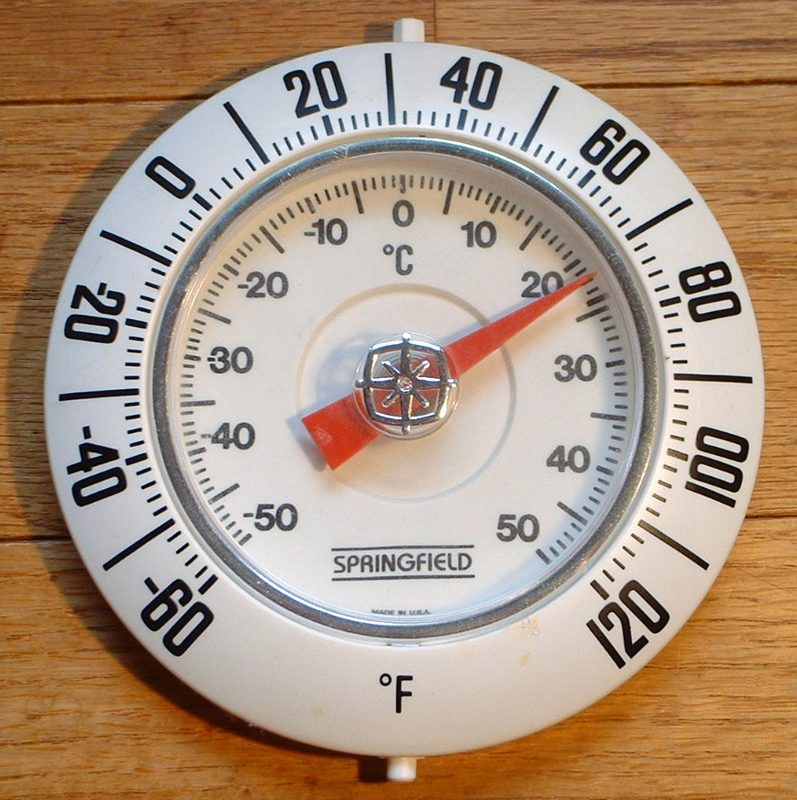
Image: Room thermometer with Fahrenheit and Celsius scales, by Stilfehler, public domain, via Wikimedia Commons.

1 thought on “Celsius to Fahrenheit: Formula, Conversion Chart and Easy Trick”