
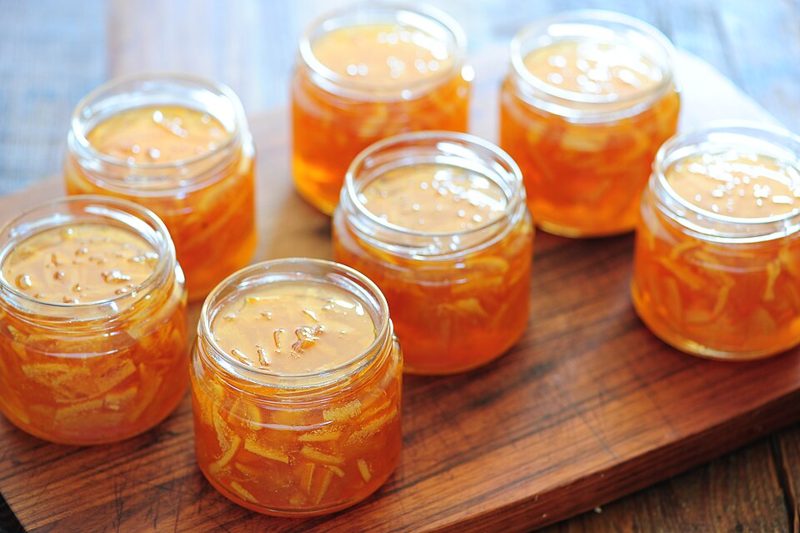
Marmalade is made of water, sugar and citrus fruit, which can be used as pulp, purée, juice, peel or a water extract of the fruit, cooked until the mixture sets into a gel.
That definition comes from the Jam and Similar Products (England) Regulations 2003, which control what can be sold as marmalade in England. The key difference from jam is the fruit: marmalade must be made from citrus fruit, while jam can be made from the pulp or purée of many kinds of fruit. At least 200 grams of citrus fruit must be used for every 1,000 grams of finished marmalade, and at least 75 grams of that must come from the endocarp, the inner part of the fruit. Like jam, standard marmalade must have a soluble dry matter content of at least 60%, measured by refractometer, while products labelled “reduced sugar” may range from 25% to 50%. A clear version that contains no insoluble matter, except possibly small amounts of finely sliced peel, is sold as “jelly marmalade.”
Source: The Jam and Similar Products (England) Regulations 2003, Schedule 1 (legislation.gov.uk)
Image: Orange marmalade, photo by jules, CC BY 2.0, via Wikimedia Commons.