
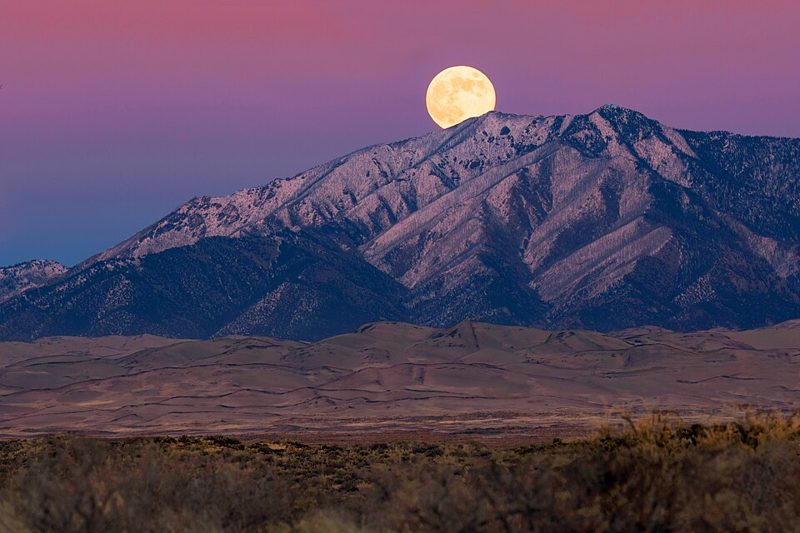
November’s full moon is called the Beaver Moon because it arrives when beavers retreat into their lodges with enough food stored for winter, and because, during the North American fur trade, it was the season to trap beavers for their thick winter pelts.
The name comes from the full moon names the Old Farmer’s Almanac has used for decades, which draw on early Native American, Colonial American, and European folklore. Traditionally, each name covered the whole lunar month in which that full moon fell, through every phase, not just the full moon itself. November’s other names also describe animals and weather getting ready for winter: the Tlingit Digging or Scratching Moon, the Dakota and Lakota Deer Rutting Moon, the Algonquin Whitefish Moon, the Cree and Assiniboine Frost Moon, and the Anishinaabe Freezing Moon. In 2026, the Beaver Moon reaches full illumination on Tuesday, November 24, at 9:53 a.m. EST, so the best viewing is on the evenings of November 23 and 24. It is also a supermoon, the first of three in a row, and it can look up to 8% larger and 16% brighter than an average full moon.
Source: The Old Farmer’s Almanac, “Full Beaver Supermoon November 2026: Date, Meaning, and Best Viewing”
Image: Beaver Moon over the dunes and Mt. Zwischen, Great Sand Dunes National Park and Preserve (NPS), public domain, via Wikimedia Commons.