
Last updated: November 11, 2026
What is Kwanzaa? Kwanzaa is an annual African American and Pan-African cultural holiday celebrated from December 26 to January 1. Created in 1966 by Dr. Maulana Karenga, it dedicates each of its seven days to one of seven principles, the Nguzo Saba, and families mark each day by lighting a candle on the kinara.
Below are the 2026 dates, the principles, symbols, colors and candle order, and traditional customs, drawn from the official Kwanzaa website.
Contents
- What is Kwanzaa and why was it created?
- When is Kwanzaa in 2026?
- What are the 7 principles of Kwanzaa?
- What are the symbols of Kwanzaa?
- Kwanzaa colors and candles: what do they mean?
- How to celebrate Kwanzaa
- Frequently asked questions
What is Kwanzaa and why was it created?
Dr. Maulana Karenga, a professor of Africana studies, created Kwanzaa in 1966 (Britannica). The official Kwanzaa FAQ says it was created by the Organization Us to reaffirm African cultural values and strengthen family, community and culture (Official Kwanzaa Website).
Where the name comes from
The word comes from the Swahili phrase matunda ya kwanza, meaning “first fruits.” Because kwanza has only six letters, an extra “a” was added so that each of seven children at an early celebration could represent one letter (Official Kwanzaa Website). Britannica notes that Kwanzaa, spelled this way, is not itself a Swahili word.
Why Kwanzaa lasts seven days
Kwanzaa is modeled on African first-fruits celebrations such as the seven-day Umkhosi of Zululand, but the main reason is to give one day to each of the seven principles (Official Kwanzaa Website).
When is Kwanzaa in 2026?
Kwanzaa always runs from December 26 to January 1 (Britannica). Many guides list only the start and end dates, so the table below shows each 2026 date with its principle and candle color.
| Day | Date | Principle (Swahili) | English meaning | Candle color |
|---|---|---|---|---|
| 1 | Saturday, Dec. 26, 2026 | Umoja | Unity | Black |
| 2 | Sunday, Dec. 27, 2026 | Kujichagulia | Self-determination | Red |
| 3 | Monday, Dec. 28, 2026 | Ujima | Collective work and responsibility | Green |
| 4 | Tuesday, Dec. 29, 2026 | Ujamaa | Cooperative economics | Red |
| 5 | Wednesday, Dec. 30, 2026 | Nia | Purpose | Green |
| 6 | Thursday, Dec. 31, 2026 | Kuumba | Creativity | Red |
| 7 | Friday, Jan. 1, 2027 | Imani | Faith | Green |
Candle colors follow the official assignment of principles to the black, red and green candles (Official Kwanzaa Website). Kwanzaa begins a few days after the December winter solstice.
What are the 7 principles of Kwanzaa?
The Kwanzaa principles, the Nguzo Saba, are the core of the holiday. The official website describes them as communitarian African values (Official Kwanzaa Website):
- Umoja (Unity): striving for and maintaining unity in the family, community, nation and race. It is the foundational principle.
- Kujichagulia (Self-determination): to define, name, create for and speak for ourselves.
- Ujima (Collective work and responsibility): building and maintaining the community together and solving shared problems together.
- Ujamaa (Cooperative economics): building and maintaining community-owned stores, shops and other businesses and profiting from them together.
- Nia (Purpose): making the building and development of the community a shared calling.
- Kuumba (Creativity): doing as much as possible to leave the community more beautiful and beneficial than it was inherited.
- Imani (Faith): believing wholeheartedly in our people, parents, teachers and leaders and in the righteousness of the struggle.
What are the symbols of Kwanzaa?
The Kwanzaa symbols include seven basic ones and two supplemental ones, each with a Swahili name (Official Kwanzaa Website):
- Mazao (the crops): African harvest celebrations and the rewards of collective work.
- Mkeka (the mat): tradition and history, the foundation on which everything else is built.
- Kinara (the candle holder): African roots, the parent people of the continent.
- Muhindi (the corn): children and the future they embody.
- Kikombe cha Umoja (the unity cup): the principle and practice of unity.
- Mishumaa Saba (the seven candles): the Seven Principles.
- Zawadi (the gifts): the work and love of parents and the commitments children make and keep.
The two supplemental symbols are the Bendera (the black, red and green flag) and a Nguzo Saba poster or other written copy of the Seven Principles, which the official site says should always be part of a Kwanzaa set.
Kwanzaa colors and candles: what do they mean?
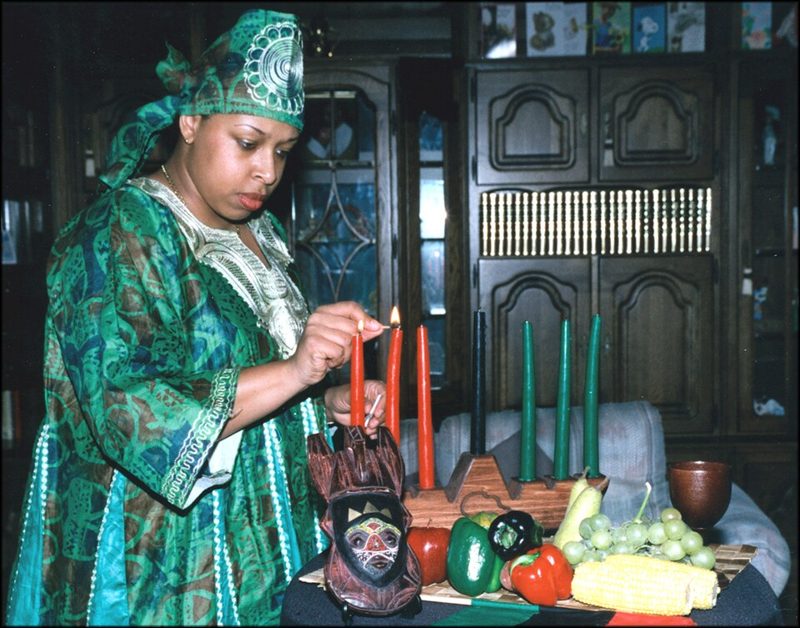
The Kwanzaa colors are black, red and green: black for the people, red for their struggle, and green for the future and hope that come from their struggle. The kinara holds one black candle, three red candles and three green candles (Official Kwanzaa Website).
How to arrange and light the Kwanzaa candles
- Choose a central place in the home and cover a table with African cloth.
- Lay the mkeka (mat) on the table and place the other symbols on it or beside it.
- Set the kinara on the mat with the black candle in the center.
- Place the three red candles, for Kujichagulia, Ujamaa and Kuumba, to the left of the black candle.
- Place the three green candles, for Ujima, Nia and Imani, to the right.
- Light the black candle on the first day, then light the remaining candles from left to right on the following days.
This order shows the people first, then the struggle, then the hope (Official Kwanzaa Website).
Kwanzaa candles vs. the menorah
The kinara resembles a menorah, but Kwanzaa has no connection to Judaism (Britannica). See how to light a menorah.
How to celebrate Kwanzaa
Each day, families gather to light that day’s candle and discuss its principle (Britannica).
- Use the Kwanzaa greeting. The greeting is “Habari gani?” and the answer is the principle of the day, for example “Umoja” on December 26 (Official Kwanzaa Website).
- Hold the karamu. On December 31, families join in a community feast called the karamu (Britannica).
- Decorate in Kwanzaa colors with traditional African items such as baskets, cloth and art (Official Kwanzaa Website).
- Send Kwanzaa cards. If you mail them, see how to address an envelope.
The gift rule many guides leave out
Gifts, called zawadi, are given mainly to children, and the official guidance says they must always include a book and a heritage symbol. The book stresses the value of learning, and the heritage symbol reaffirms commitment to tradition and history (Official Kwanzaa Website).
Can anyone celebrate Kwanzaa?
Kwanzaa was created for African peoples, but Karenga’s FAQ says others can and do take part, as at public school or college events, while each community should conduct its own rituals (Official Kwanzaa Website). For another festival of light, read why Diwali is celebrated.
Frequently asked questions
When is Kwanzaa 2026?
Kwanzaa runs from December 26 to January 1 every year. In 2026 it begins on Saturday, December 26, 2026, and ends on Friday, January 1, 2027.
What does the word Kwanzaa mean?
The name comes from the Swahili phrase matunda ya kwanza, which means first fruits. The extra a was added so the word would have seven letters, one for each of seven children at an early celebration.
Is Kwanzaa a religious holiday?
No. Kwanzaa is a cultural holiday, not a religious one, and people of many faiths celebrate it, including Christians and Muslims.
What do you say on Kwanzaa?
The traditional greeting is the Swahili question Habari gani? The reply is the principle of that day, such as Umoja on the first day and Kujichagulia on the second.
What are the 3 colors of Kwanzaa?
The colors are black, red and green. Black stands for the people, red for their struggle, and green for the future that comes from their struggle.
Can you celebrate Kwanzaa and Christmas?
Yes. Kwanzaa was not created as an alternative to anyone’s religion or religious holiday, and many Christians celebrate it.
Sources
- Official Kwanzaa Website: Frequently Asked Questions About Kwanzaa
- Official Kwanzaa Website: The Celebration and Candle Lighting
- Official Kwanzaa Website: The Symbols of Kwanzaa
- Official Kwanzaa Website: Greetings, Gifts, and Colors and Decorations
- Britannica: Kwanzaa
Featured image: A Kwanzaa candle-lighting demonstration with the kinara, crops, corn and unity cup. Photo by Christopher Myers, U.S. Government work, public domain, via Wikimedia Commons.
