
Last updated: November 29, 2026
LingSante 3.1 is Ant Group’s open-weight medical AI family, released on Hugging Face under the MIT license. LingSante-3.1-flash is a 560B mixture-of-experts text model with 25B active parameters and a 1M-token context, and LingSante-3.1-air-VL is a 124B image-and-text model. Both are research models, not medical devices.
Contents
- What LingSante 3.1 includes
- LingSante 3.1 models compared
- Benchmarks: where it leads and trails
- How to run LingSante-3.1-flash
- Using LingSante-3.1-air-VL for images
- Practical workflows and prompt patterns
- Known limitations and responsible use
- Frequently asked questions
What LingSante 3.1 includes
LingSante comes from inclusionAI, the Ant Group lab behind the Ling models. A sponsored MarkTechPost article reports that LingSante powers Ant’s Afu health app, which Ant says serves 150 million users (MarkTechPost). The Hugging Face repositories for the first open models were created on November 19, 2026, and news coverage followed through November 28.
The open release has four parts:
- LingSante-3.1-flash: a text model for medical reasoning, professional communication, evidence-based deep research and long, multi-step medical tasks (model card).
- LingSante-3.1-air-VL: a multimodal model that reads text and images, covering imaging reports, skin, diet and lab report assessment, medical search and GUI agents (model card).
- LingSante-3.1-flash-MXFP4: a smaller quantized checkpoint of the flash model (model card).
- LingSante-Pulse-1.0: a physiological signal encoder for data such as ECG leads (model card).
MarkTechPost reports that LingSante-MedGuard and LingSante-Live remain closed (MarkTechPost). If you follow Ant’s general models, our Ling-3.2-air self-hosting guide and Ling-3.2-flash guide cover the base family.
LingSante 3.1 models compared
| Spec | LingSante-3.1-flash | LingSante-3.1-air-VL |
|---|---|---|
| Total parameters | 560B | 124B |
| Active per token | 25B | 5.5B |
| Input | Text | Text and images |
| Context window | 1M tokens (MXFP4 build: 262,144) | 256K tokens (with YaRN) |
| Base model | Ling-3.1-flash | Ling-3.0-flash-VL |
| License | MIT | MIT |
| Reference hardware | 8x H200 or 4x GB300 | 4x 141GB-class or 8x 80GB H100/H800 |
The flash model uses a hybrid-linear MoE design: 63 KDA layers and 9 gated MLA layers (a 7:1 ratio), 512 routed experts plus 1 shared expert, 8 routed experts active per token (model card). The previous healthcare release, Ling-3.0-flash-Sante, had 124B total and 5.1B active parameters, so the new flash model is about 4.5 times larger in total and 5 times larger in active parameters.
Benchmarks: where it leads and trails
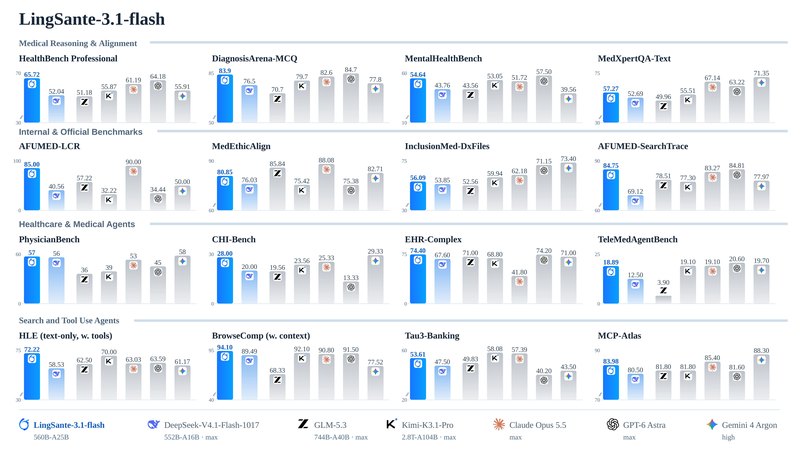
Ant trained the flash model on mixed medical and general data, then used reinforcement learning for medical reasoning, tool use, search and professional behavior, and finished with multi-teacher on-policy distillation (model card). On Ant’s own benchmark chart, it leads the comparison set on several tests:
- HealthBench Professional: 65.72, versus 64.18 for GPT-6 Astra and 61.19 for Claude Opus 5.5.
- EHR-Complex: 74.40, versus 74.20 for GPT-6 Astra.
- BrowseComp (with context): 94.10, versus 92.10 for Kimi-K3.1-Pro.
It trails on other tests in the same chart. Gemini 4 Argon scores 73.40 on InclusionMed-DxFiles against 56.09, and Claude Opus 5.5 scores 67.14 on MedXpertQA-Text against 57.27. The card also says the model ranks fifth of 23 configurations on the InclusionMed benchmark with an overall score of 45.064, and second on medical professional behavior behind GPT-6 Astra (model card). MarkTechPost notes it is weaker on general coding and terminal agent tasks (MarkTechPost). All of these figures are self-reported by Ant.
How to run LingSante-3.1-flash
SGLang is the recommended runtime. The card provides a day-0 image with MTP (NEXTN) speculative decoding and Hopper decode optimizations (model card). For background on the runtime, see our SGLang 0.5.23 guide.
- Pull the image:
docker pull lmsysorg/sglang:dev-ling-3.1-flash. - Launch the server on 8 H200 GPUs with
python3 -m sglang.launch_server --model-path inclusionAI/LingSante-3.1-flash --tp 8 --ep 8 --speculative-algorithm NEXTN --host 0.0.0.0 --port 30000. On 4 GB300 GPUs, use--tp 4 --ep 4. - Optionally set
SGLANG_ENABLE_FP8_BLOCK_GEMV=1andSGLANG_ENABLE_FUSED_KDA_OUTPUT_QUANT=1, which the card says give about 10% faster batch-1 decode on Hopper. - Send OpenAI-style requests to
/v1/chat/completionswith modelLingSante-3.1-flash,"chat_template_kwargs": {"enable_thinking": true},temperature1.0,top_p0.95 andtop_k20.
For vLLM, the card builds from the vllm branch and serves with tensor parallel size 8, expert parallelism, the ling3 tool and reasoning parsers, and 3-token MTP speculative decoding (model card). Our vLLM 0.34 guide covers the current stable release.
If 8 H200 GPUs are out of reach, the MXFP4 checkpoint quantizes only the routed experts to MXFP4 with round-to-nearest and no calibration data, and keeps other modules in FP8, BF16 or FP32. It totals 291.72 GiB and is recommended on 4 NVIDIA H20-3e GPUs with TP4 and EP4 using SGLang with Humming 0.1.12. Its configured context is 262,144 tokens, and Ant notes its published scores belong to the source model, not the quantized build (MXFP4 card).
Using LingSante-3.1-air-VL for images
The air-VL model targets four areas: imaging reports, multimodal health assessment, medical search with evidence synthesis, and medical GUI agents (model card). Ant says it can identify 8 to 9 types of positive findings on one complex chest X-ray. It covers more than 120 skin conditions and asks follow-up questions before giving an assessment.
To serve it, use the lmsysorg/sglang:dev-Ling-3.0-flash-VL image with --tp 4 on 141GB-class GPUs (or --tp 8 on 80GB H100 or H800), --context-length 262144, a YaRN rope override, and the ling3 reasoning and tool parsers. Send images as image_url parts in the message content (model card). GUI and tool workflows need an external environment that supplies tools and validates actions.
Practical workflows and prompt patterns
- Evidence synthesis: give the flash model a set of papers or guidelines and ask it to list each claim with the supporting passage, then flag conflicts between sources. The card warns that long context does not guarantee every fact is retrieved.
- Clinical document extraction: ask for structured JSON fields from discharge notes or lab reports, with a human reviewer checking each record.
- Draft imaging reports: with air-VL, request Findings and Impression sections, then have a qualified reader compare them with the original images.
For a general-purpose open model at a similar scale, compare our GigaChat 4 guide.
Known limitations and responsible use
- Not a medical device. Outputs may be wrong, incomplete, outdated or unsupported by the cited evidence (model card).
- Benchmark and simulated-environment results do not establish clinical effectiveness, and performance can vary by specialty, language, population and institution.
- Image quality, lighting and missing context can change air-VL interpretations (model card).
- Give agents least-privilege tool access and require human approval for consequential actions; tool outputs can contain malicious instructions.
- LingSante-Pulse outputs signal features only. Task-specific prediction heads are not included (Pulse card).
Frequently asked questions
What is LingSante 3.1?
LingSante 3.1 is Ant Group’s open-weight medical model family from its inclusionAI team. It includes LingSante-3.1-flash, a 560B-parameter text model with 25B active parameters, and LingSante-3.1-air-VL, a 124B multimodal model with 5.5B active parameters. Both use the MIT license.
Is LingSante free to use?
The weights are free to download from Hugging Face and ModelScope under the MIT license, but you need your own multi-GPU servers. The card also links a hosted API on Computrix, but this guide did not find published pricing.
What hardware does LingSante-3.1-flash need?
The model card’s SGLang recipe uses 8 H200 GPUs (TP8 plus EP8) or 4 GB300 GPUs. The MXFP4 checkpoint is about 292 GiB and is recommended on 4 NVIDIA H20-3e GPUs.
Can LingSante diagnose patients?
No. Ant Group says the models are for research and evaluation, are not medical devices, and must not be used on their own to diagnose, prescribe, choose treatment or make triage decisions. Qualified people must review outputs.
What is LingSante-Pulse?
LingSante-Pulse-1.0 is an MIT-licensed physiological signal encoder that turns signals such as an ECG lead into feature vectors. It has no task-specific prediction heads.
How does LingSante-3.1-flash compare with GPT-6 Astra?
On Ant’s own chart it scores 65.72 on HealthBench Professional versus 64.18 for GPT-6 Astra, but GPT-6 Astra leads on several other medical tests. These are vendor-reported results, not independent evaluations.
Sources
- LingSante-3.1-flash model card (inclusionAI, Hugging Face)
- LingSante-3.1-air-VL model card (inclusionAI, Hugging Face)
- LingSante-3.1-flash-MXFP4 model card (inclusionAI, Hugging Face)
- LingSante-Pulse-1.0 model card (inclusionAI, Hugging Face)
- MarkTechPost: Ant Group releases LingSante-3.1-flash (November 28, 2026, sponsored)
Featured image: benchmark overview chart from the LingSante-3.1-flash model card by inclusionAI (Ant Group), MIT-licensed repository; resized. FreeAnswers is not affiliated with Ant Group.