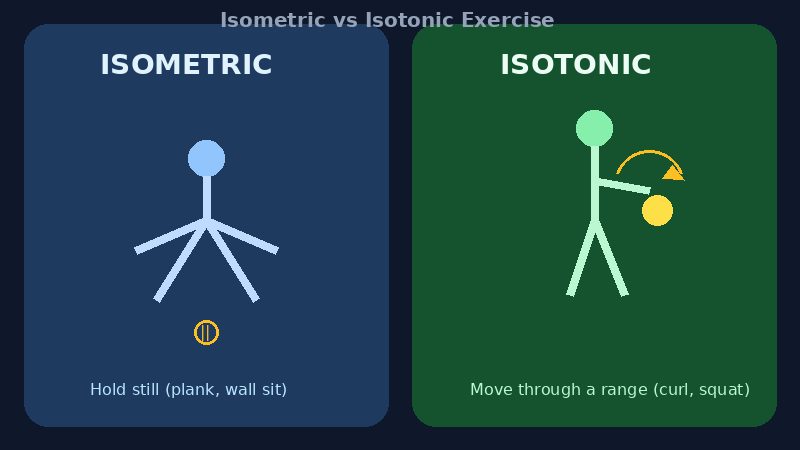
Isotonic exercise involves muscle contraction with movement: the muscle shortens or lengthens as a joint moves through a range of motion. Common examples include push-ups, squats, and dumbbell curls.
Isometric exercise involves muscle contraction without changing muscle length or joint angle—you hold a static position against resistance. Examples include planks, wall sits, and squat holds.
Isotonic work is typically used to build strength and endurance through movement; isometric holds can raise heart rate and blood pressure, so people with hypertension should check with a clinician before relying on them. Many balanced strength routines include both types.
Source: UNC Student Wellness — Isotonic and Isometric Exercise.