
Last updated: November 21, 2026
To do a plank, lie face down, place your elbows directly under your shoulders and tuck your toes. Tighten your abs and legs, then lift your body into one straight line from head to heels. Keep your gaze down, breathe steadily and hold for 10 to 30 seconds before lowering.
This guide explains how to do a plank correctly, how long to hold it, which muscles it works, common mistakes, and easier or harder variations.
Contents
- How to do a plank: step-by-step instructions
- What muscles do planks work?
- How long should you hold a plank?
- Plank variations for beginners and advanced exercisers
- Is it better to plank on elbows or hands?
- How many planks a day should you do?
- Common plank mistakes and how to fix them
- Plank vs. sit-up: which is better for your core?
- Frequently asked questions
How to do a plank: step-by-step instructions
These steps for the forearm (low) plank follow the American Council on Exercise (ACE) and Harvard Health.
- Get into position. Lie on your stomach on a mat or towel with your elbows directly under your shoulders and your palms down.
- Set your legs. Straighten your legs, keep your feet together and pull your toes toward your shins so they press into the floor.
- Brace your core. Tighten your abdominal muscles to stiffen your torso before you move.
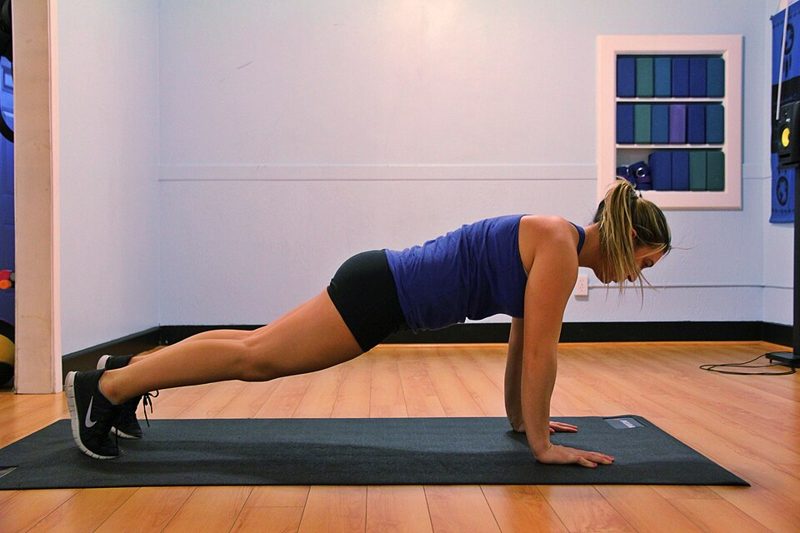
- Lift up. Push into your forearms and raise your body until it forms a straight line from your head and neck to your feet. Do not let your hips rise or sag.
- Hold and breathe. Keep your gaze down, your shoulders over your elbows and your shoulders relaxed rather than shrugged. Take steady, even breaths.
- Lower with control. Keep your torso stiff and knees straight as you lower your body back to the mat, then rest.
One hold followed by rest counts as one set. Harvard Health suggests working toward two to three sets (Harvard Health). ACE advises stopping immediately and consulting a doctor if you feel pain in your lower back (ACE).
What muscles do planks work?
Planks work the core, the group of muscles between the pelvic floor and the diaphragm that supports movement and stabilizes the spine. According to Cleveland Clinic, the main core muscles involved are:
- Rectus abdominis: the muscle usually called the “abs.”
- Obliques: the muscles along the sides of your abdomen.
- Transversus abdominis: a deep abdominal muscle that wraps around your sides and spine.
Planks can also activate the glutes, hamstrings and lower back. Because you hold still, a plank is an isometric exercise; see our explainer on the difference between isometric and isotonic exercise.
How long should you hold a plank?
Most experts suggest 10 to 30 seconds is plenty, done as several short sets (Harvard Health). As you progress, you can extend a plank to one or two minutes; two minutes is often considered the maximum, with little extra benefit beyond it. To build up (Cleveland Clinic):
- Add time in small steps of 5 to 10 seconds.
- Once you can hold a position for more than a minute, move on to a harder variation instead of simply holding longer.
Plank variations for beginners and advanced exercisers
If a full plank is too hard, start with an easier version. The table lists common options from easiest to hardest.
| Variation | How to do it | Best for |
|---|---|---|
| Counter (incline) plank | Stand and lean against a counter so your body is at a 45-degree angle (Harvard Health). | People with back issues or very new exercisers |
| Modified (knee) plank | Start in a push-up position and drop your knees to the floor while bracing your core (Cleveland Clinic). | Beginners building up to a full plank |
| Low (forearm) plank | Rest on your forearms and toes with your body in a straight line (ACE). | The standard plank for most people |
| High plank | Hold the top of a push-up position with your arms straight (Cleveland Clinic). | People whose forearms are uncomfortable |
| Plank with leg lifts | Raise one leg for a second or two, then switch legs (Harvard Health). | Exercisers who can hold a plank for a minute or more |
| Side plank | Lie on your side, prop yourself up on your forearm and raise your hips into a straight line (Cleveland Clinic). | Targeting the obliques |
Cleveland Clinic suggests mastering the knee plank first and moving to the low plank once you can do three sets of one minute (Cleveland Clinic).
Is it better to plank on elbows or hands?
Both versions train the core, so choose the one you can hold with good form. Harvard Health suggests switching to the push-up position, with your arms fully extended, if resting on your forearms is uncomfortable (Harvard Health).
The high plank is also the starting position of a push-up. See our guide on how to do a push-up with proper form for the next step, and our list of good upper body exercises for more ideas.
How many planks a day should you do?
There is no single required number. You can plank every day, on alternate days or as part of regular workouts (Harvard Health). Cleveland Clinic recommends planking two to four times a week for the most benefit (Cleveland Clinic).
Planks count as muscle-strengthening activity. The Physical Activity Guidelines for Americans advise adults to do muscle-strengthening activity at least 2 days each week, plus 150 to 300 minutes of moderate-intensity aerobic activity (ODPHP). For the aerobic side, see how many steps a day you need.
Common plank mistakes and how to fix them
- Sagging or raised hips: tighten your abs and glutes until your body forms a straight line (ACE).
- Bent knees: contract your thigh muscles to keep your legs straight.
- Shrugged shoulders: keep your shoulders directly over your elbows.
- Craning your neck: keep your gaze on the floor so your head lines up with your spine (Harvard Health).
- Holding your breath: breathe steadily throughout the hold.
A plank should not cause back or shoulder pain; if it does, your form may be off. A photo or video of yourself can show what to change (Cleveland Clinic).
Plank vs. sit-up: which is better for your core?
A physical therapist quoted by Harvard Health explains that the standard sit-up targets only part of the core, and its forward-bending motion can strain the neck and lower back. The plank activates all the core muscles at once without extra movement, and its many modifications make it suitable for almost anyone (Harvard Health).
Planks are also free, take only a couple of minutes and need no equipment, and a strong core helps protect your spine during everyday lifting (Cleveland Clinic).
Frequently asked questions
How long should a beginner hold a plank?
Start with 10 to 30 seconds and repeat for two to three sets. Harvard Health reports that most experts consider 10 to 30 seconds plenty, with longer holds added as you get stronger.
Is it OK to do planks every day?
Yes. Harvard Health says you can plank every day, on alternate days or as part of your regular workouts. Cleveland Clinic recommends planking two to four times a week.
Do planks burn belly fat?
Not on their own. A Cleveland Clinic exercise physiologist says the promise of a six-pack from planks is overblown and that visible abs are more related to diet.
What muscles do planks work?
Planks mainly work the core, including the rectus abdominis, obliques and transversus abdominis. They can also activate the glutes, hamstrings and lower back.
What is the world record for holding a plank?
Harvard Health notes that the world record for holding a plank is more than four hours. For fitness, holds of up to one or two minutes are enough.
Sources
- American Council on Exercise: Front Plank
- Harvard Health Publishing: Straight talk on planking
- Cleveland Clinic: Plank exercises and what they do for your body
- ODPHP: Top 10 things to know about the Physical Activity Guidelines for Americans
Featured image: “Plank” by Jaykayfit, licensed under CC BY-SA 3.0, via Wikimedia Commons; resized.
