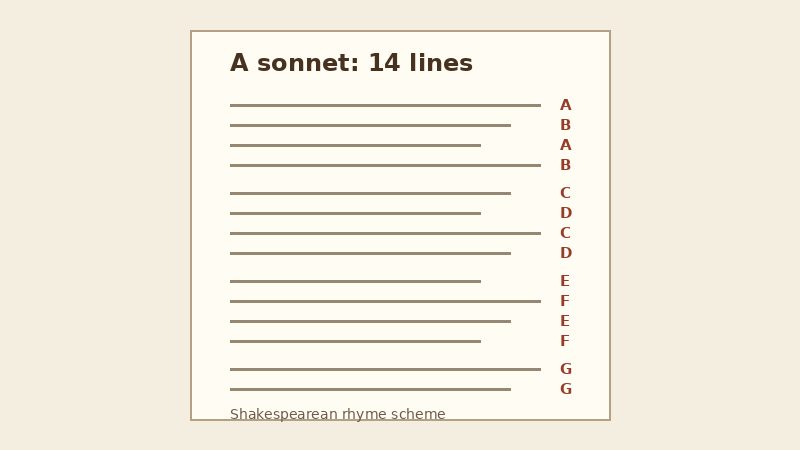
A sonnet is a 14-line poem, literally a “little song,” that traditionally reflects on a single sentiment and ends with a clarification or “turn” of thought in its closing lines. The form began in Italy and was brought to England in the 16th century by Sir Thomas Wyatt and Henry Howard, Earl of Surrey.
The two best-known types are built differently. A Petrarchan sonnet splits the 14 lines into an eight-line octave rhyming ABBAABBA and a six-line sestet rhyming CDCDCD or CDECDE. An English (Shakespearean) sonnet uses three four-line quatrains and a closing couplet, rhyming ABAB CDCD EFEF GG, though poets often vary the scheme.