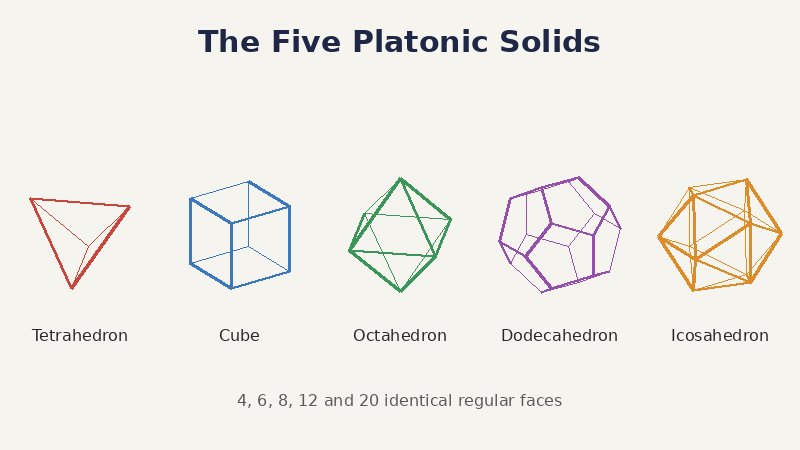
The Platonic solids are the five regular polyhedra: the tetrahedron (4 triangular faces), the cube (6 square faces), the octahedron (8 triangular faces), the dodecahedron (12 pentagonal faces) and the icosahedron (20 triangular faces). Britannica describes them as solids whose faces are all identical regular polygons meeting at the same three-dimensional angles.
They are named after the Greek philosopher Plato, who in his dialogue Timaeus linked them to fire, earth, air, water and the heavens. Euclid gave the first known proof that exactly five such solids exist, in the final book of his Elements.