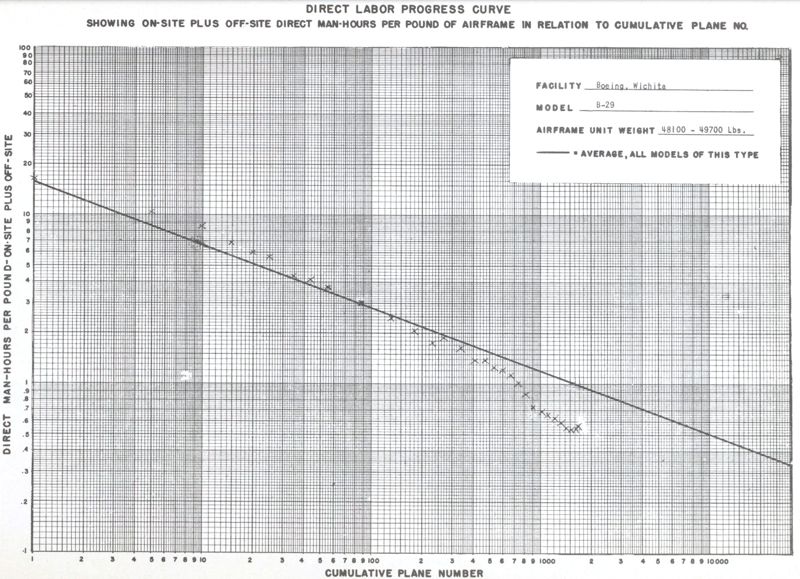
A learning curve is a graph of how proficiency at a task changes with experience: performance usually improves, often quickly at first and then more slowly, the more a person, team or company repeats the task. Psychologist Hermann Ebbinghaus first charted it in his 1885 memory experiments, and the term itself was in use by 1903.
In industry, engineer Theodore Paul Wright showed in 1936 that aircraft unit costs fell about 20% each time cumulative production doubled, a pattern now called the experience curve or Wright’s law. In everyday speech, a “steep learning curve” usually means something is hard to learn, even though on the original graph a steep rise means rapid progress.
Source: Learning curve, Wikipedia
Image: B-29 direct labor progress curve, US Army Air Forces Air Materiel Command, public domain, via Wikimedia Commons.