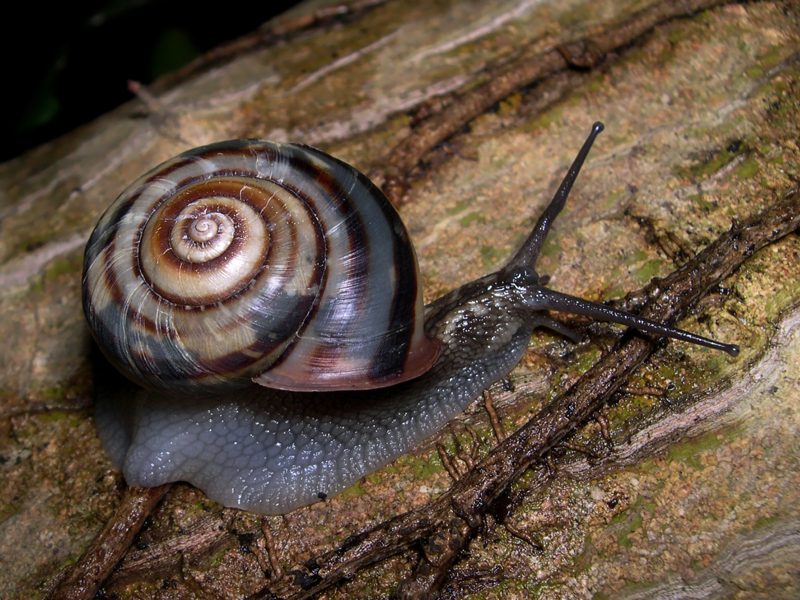
Most snail shells coil to the right (clockwise when viewed from the tip), but some species coil to the left and a few have both forms. A 2026 study of wild Japanese Euhadra snails by researchers from the University of Nottingham and Tohoku University found that the coiling direction, or chirality, comes down to natural variation in a gene for the protein myosin, which helps cells move and change shape.
Small differences in that myosin protein appear to change whether cells twist clockwise or counterclockwise in the earliest stages of the embryo, which sets the handedness of the adult shell and body organs. Both the left- and right-coiling Euhadra forms develop normally, whereas in pond snails, left-coiling is caused by a mutation in a different gene that also disrupts development. The study was published in Current Biology.
Image: Euhadra peliomphala, a Japanese land snail, by Takahashi, public domain, via Wikimedia Commons.
Related answers
- Is Oumuamua still debated among top scientists?
- What are the winter 2026/2027 snowfall predictions?
- Did a microalgae bloom shut down Israel’s desalination plants?