
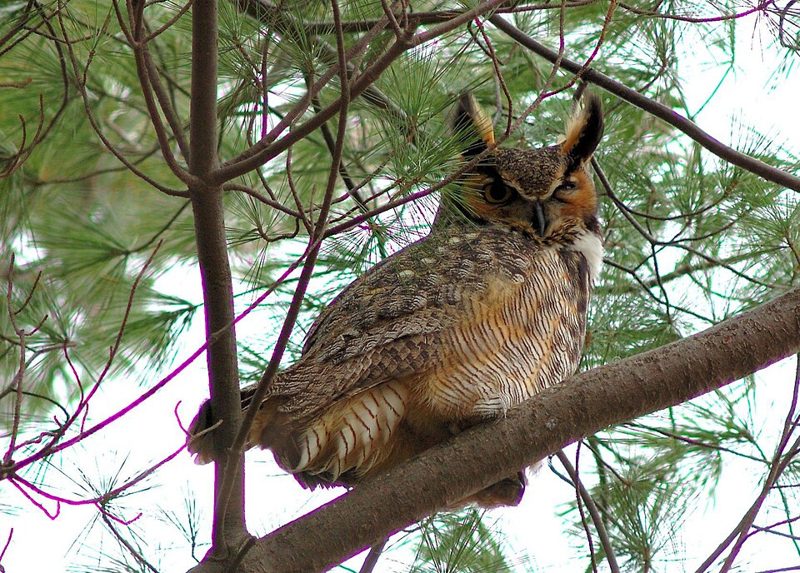
Often, yes: great horned owl pairs typically breed together year after year and may mate for life, although they spend less time together once their young are mostly independent.
The pair bond is renewed each breeding season. In most of North America, courtship runs from October to December, and mates are chosen by December or January, which is why the owls are especially vocal in late fall. Males hoot emphatically for about a month to six weeks toward the end of the year, while females join in for only about a week to ten days. Established pairs that rekindle their relationship in winter often perform a milder courtship to strengthen the bond before nesting. The species was long thought to be strictly monogamous, but in 2018 researchers in Reno, Nevada, documented one male mating with two females at the same time, so lifelong pairing is the usual pattern rather than an absolute rule. Great horned owls usually take over old nests built by hawks, crows or other large birds instead of building their own.
Source: Wikipedia, Great horned owl
Image: Great horned owl, U.S. Fish and Wildlife Service, public domain, via Wikimedia Commons.