
Last updated: October 28, 2026
To convert km to miles, divide the number of kilometers by 1.609344, or multiply it by about 0.621371. One kilometer is about 0.62 miles, and one mile is exactly 1.609344 kilometers. For example, 10 km is about 6.21 miles and 100 km is about 62.14 miles.
This guide gives the exact formula, a kilometers to miles chart, speed and running pace conversions, and two easy mental math tricks. The conversion factors come from the National Institute of Standards and Technology (NIST).
Contents
- Km to miles formula
- Km to miles conversion chart
- How to convert km to miles in your head
- Km/h to mph conversion
- Race distances in km and miles
- Km to miles pace conversion
- Nautical miles and survey miles
- Frequently asked questions
Km to miles formula
NIST’s official conversion factor table (SP 811, Appendix B) lists 1 mile as exactly 1.609 344 kilometers. That gives two equivalent formulas:
- Miles = kilometers ÷ 1.609344 (exact)
- Miles = kilometers × 0.621371 (accurate to six digits)
- Kilometers = miles × 1.609344 (for the reverse, miles to km)
Worked example
- Start with the distance in kilometers. Say a road sign reads 42 km.
- Divide by 1.609344. 42 ÷ 1.609344 = 26.097.
- Round to a sensible precision. For driving or walking, 26.1 miles is plenty.
- Check the size. The miles figure should always be about 60% of the kilometers figure.
For a quick estimate, NIST’s approximate metric conversion card (SP 365) rounds the factor to 0.62, which is close enough for travel and everyday use.
Km to miles conversion chart
This kilometers to miles chart is calculated from the exact NIST factor and rounded to two decimal places.
| Kilometers | Miles |
|---|---|
| 1 km | 0.62 mi |
| 2 km | 1.24 mi |
| 3 km | 1.86 mi |
| 5 km | 3.11 mi |
| 8 km | 4.97 mi |
| 10 km | 6.21 mi |
| 15 km | 9.32 mi |
| 20 km | 12.43 mi |
| 25 km | 15.53 mi |
| 30 km | 18.64 mi |
| 40 km | 24.85 mi |
| 50 km | 31.07 mi |
| 60 km | 37.28 mi |
| 75 km | 46.60 mi |
| 80 km | 49.71 mi |
| 100 km | 62.14 mi |
| 150 km | 93.21 mi |
| 200 km | 124.27 mi |
| 500 km | 310.69 mi |
| 1,000 km | 621.37 mi |
To read the chart in reverse, remember that 1 mile is about 1.61 km, 5 miles about 8.05 km and 10 miles about 16.09 km.
How to convert km to miles in your head
When you do not have a calculator, these methods get you close:
- Multiply by 5, then divide by 8. Five-eighths is 0.625, very close to 0.621. Example: 40 km × 5 = 200, and 200 ÷ 8 = 25 miles (exact: 24.85).
- Halve it, then add a tenth of the original. Half of 90 km is 45; a tenth of 90 is 9; 45 + 9 = 54 miles (exact: 55.92). This slightly underestimates.
- Use the 0.6 rule for small numbers. 3 km × 0.6 = 1.8 miles (exact: 1.86).
All three tricks keep the error within a few percent, which is fine for road signs, hiking trails and treadmill readouts.
Km/h to mph conversion
Speed converts with the same factor. NIST lists 1 mile per hour as exactly 1.609 344 km/h, so divide km/h by 1.609344 to get mph. Speeds you often see on road signs abroad:
| Km/h | Mph (approx.) |
|---|---|
| 30 km/h | 19 mph |
| 40 km/h | 25 mph |
| 50 km/h | 31 mph |
| 60 km/h | 37 mph |
| 70 km/h | 43 mph |
| 80 km/h | 50 mph |
| 90 km/h | 56 mph |
| 100 km/h | 62 mph |
| 110 km/h | 68 mph |
| 120 km/h | 75 mph |
| 130 km/h | 81 mph |
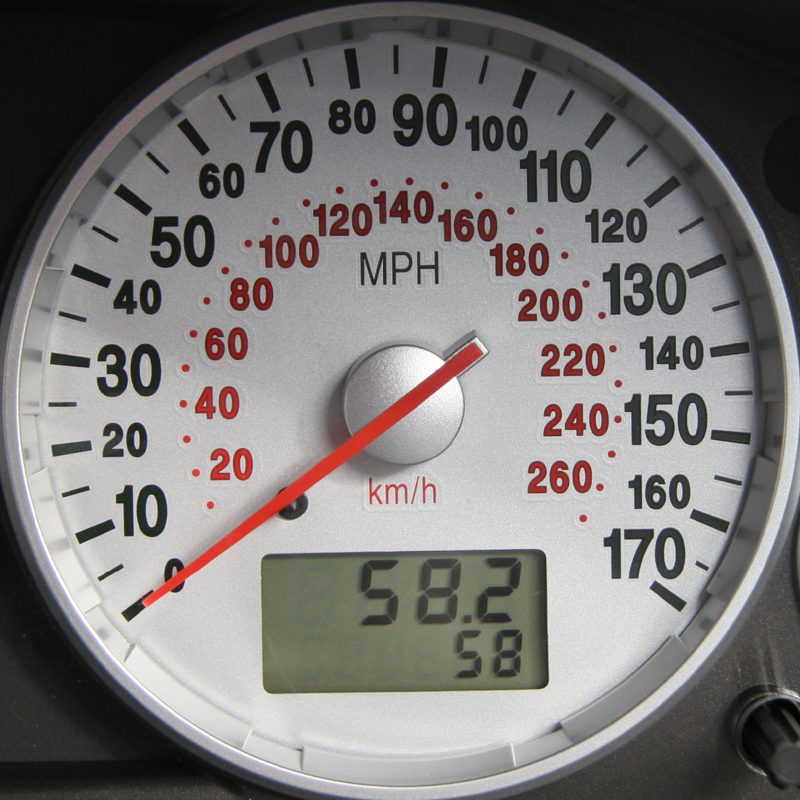
Many cars sold in countries that use both systems show both scales on the speedometer, as in the photo above, with mph on the outer ring and km/h on the inner ring.
Race distances in km and miles
Most road races are measured in kilometers. World Athletics says the marathon distance is 26 miles 385 yards (42.195 km), standardized in 1921, and the half marathon is 21.0975 km, or 13.1094 miles.
| Race | Kilometers | Miles |
|---|---|---|
| 5K | 5 km | 3.11 mi |
| 10K | 10 km | 6.21 mi |
| 15K | 15 km | 9.32 mi |
| Half marathon | 21.0975 km | 13.11 mi |
| Marathon | 42.195 km | 26.22 mi |
| 50K ultramarathon | 50 km | 31.07 mi |
| 100K ultramarathon | 100 km | 62.14 mi |
For more on these distances, see how many miles a marathon is, how long a half marathon is and the length of an Olympic triathlon. If you track walking instead, our answer on how many steps are in a mile helps turn distance into steps.
Km to miles pace conversion
Pace works the other way from distance. Because a mile is longer, a pace per mile is a bigger number than the same pace per kilometer. Multiply minutes per kilometer by 1.609344 to get minutes per mile.
| Pace per km | Pace per mile | 5K finish time |
|---|---|---|
| 3:00 /km | 4:50 /mi | 15:00 |
| 3:30 /km | 5:38 /mi | 17:30 |
| 4:00 /km | 6:26 /mi | 20:00 |
| 4:30 /km | 7:15 /mi | 22:30 |
| 5:00 /km | 8:03 /mi | 25:00 |
| 5:30 /km | 8:51 /mi | 27:30 |
| 6:00 /km | 9:39 /mi | 30:00 |
| 6:30 /km | 10:28 /mi | 32:30 |
| 7:00 /km | 11:16 /mi | 35:00 |
To convert in the other direction, divide minutes per mile by 1.609344. For example, a 10:00 mile pace is about 6:13 per kilometer.
Nautical miles and survey miles
Not every “mile” is the same. The NIST table lists the nautical mile, used at sea and in aviation, as exactly 1.852 km, or about 1.15 statute miles. It also lists an older U.S. survey mile of about 1.609 347 km. NIST says the U.S. survey foot became obsolete on January 1, 2023, so for everyday conversions always use 1.609344 km per mile.
If you are also converting temperatures for a trip, see our Celsius to Fahrenheit conversion guide.
Frequently asked questions
How many miles is 1 km?
One kilometer equals about 0.621371 miles. Rounded for everyday use, 1 km is about 0.62 miles.
How many km is 1 mile?
One mile is exactly 1.609344 kilometers. That value has been exact since the international yard was defined in metric terms in 1959.
How many miles is a 5K?
A 5K race is 5 kilometers, which is about 3.11 miles. A 10K is about 6.21 miles.
How do you convert km to miles quickly?
Multiply the kilometers by 0.6 and add a little, or multiply by 5 and divide by 8. For example, 80 km times 5 is 400, and 400 divided by 8 is 50 miles; the exact answer is 49.7 miles.
Is a kilometer longer than a mile?
No. A mile is about 1.6 times longer than a kilometer, so any distance is a smaller number in miles than in kilometers.
How do you convert km/h to mph?
Divide the speed in kilometers per hour by 1.609344, or multiply it by about 0.621. For example, 100 km/h is about 62 mph.
Sources
- NIST SP 811, Appendix B.8: Factors for Units Listed Alphabetically
- NIST: Approximate Conversions from Metric to U.S. Customary Measures
- NIST: U.S. Survey Foot
- World Athletics: Marathon
- World Athletics: Half Marathon
Image: “Ford Mondeo MK3 ST220 – Speedometer,” by Brian Snelson, CC BY 2.0, via Wikimedia Commons. Resized.
