
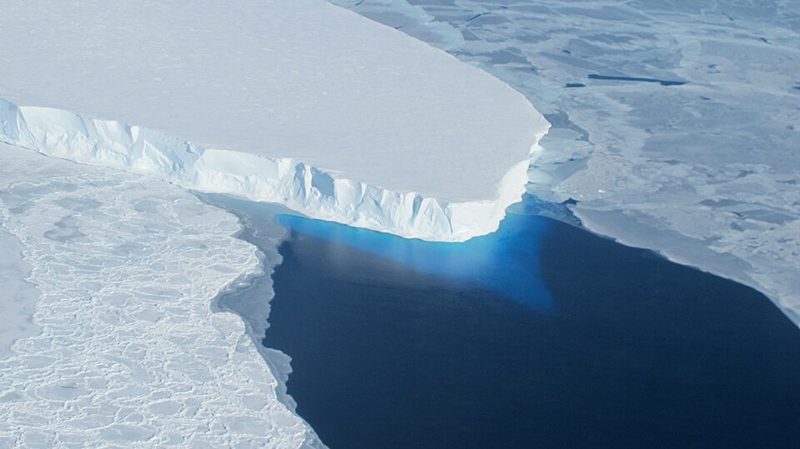
A new model suggests Thwaites Glacier could add up to 30 millimeters (about 1.2 inches) to global sea levels by 2100, roughly twice as much as earlier projections, even without additional global warming.
The study, led by Mattia Poinelli at UC Irvine and published in Nature Communications, found that warm ocean water reaches several kilometers beneath the glacier through a wide “grounding zone,” rather than stopping at a narrow grounding line as older models assumed. Radar data from Finland’s ICEYE satellites showed tides lifting the ice and repeatedly exposing its underside to warm seawater. With that physics included, the model matched changes observed since the 1990s that were four times larger than conventional models reproduced. It also gives a 60% chance that the glacier detaches from Mouginot Ridge, an underwater ridge that currently helps hold it in place, before the end of the century. Thwaites sits in West Antarctica’s Amundsen Sea Embayment, a region responsible for about one third of the Antarctic Ice Sheet’s mass loss, and the authors say the results point to greater coastal flooding risk in the coming decades.
Image: Thwaites Glacier. NASA, public domain, via Wikimedia Commons.