
Last updated: November 12, 2026
To boil eggs, place them in a single layer in a saucepan, cover them with cold water by at least 1 inch and bring it to a boil. Turn off the heat, cover the pan and let large eggs stand about 12 minutes, then cool them in ice water. Medium eggs need about 9 minutes and extra-large eggs about 15.
Below: how to boil eggs step by step, a cooking time chart by egg size, soft-boiled timings, how to peel boiled eggs easily, and how long they keep.
Contents
- How to boil eggs on the stove, step by step
- How long to boil eggs: time chart by size
- How long to boil eggs for soft-boiled or jammy yolks
- How to boil eggs for easy peeling
- Common boiled egg problems
- How to store hard-boiled eggs safely
- Frequently asked questions
How to boil eggs on the stove, step by step
These steps follow the American Egg Board method as published by Michigan State University Extension (MSU Extension) and N.C. Cooperative Extension (NC State Extension). It is also how to hard boil eggs for deviled eggs or egg salad.
- Use refrigerated, uncracked eggs. Do not wash them first and do not pierce the shells (MSU Extension).
- Arrange the eggs in one layer. Choose a saucepan large enough to hold the eggs in a single layer on the bottom.
- Cover with cold water. Add cold water until it is at least 1 inch above the eggs.
- Bring to a boil. Heat over high heat until the water boils, then turn off the heat. Move the pan off the burner if needed to stop further boiling.
- Cover and let stand. Put the lid on and let the eggs stand in the hot water: about 9 minutes for medium, 12 minutes for large and 15 minutes for extra-large eggs.
- Cool quickly. Drain the eggs and place them in ice water, or run cold water over them, until they are completely cool. NC State Extension suggests about 5 minutes in an ice bath (NC State Extension).
- Peel or refrigerate. Peel right away, or dry the eggs and refrigerate them in the shell.
Two cautions from MSU Extension: never microwave eggs in the shell, because they can burst, and true hard-boiled eggs are almost impossible to make at altitudes above 10,000 feet (MSU Extension). For the debate over the first step, see whether to start hard-boiled eggs in cold or boiling water.
How long to boil eggs: time chart by size
Egg size changes the cooking time. USDA size classes are based on the minimum weight per dozen, not on how big each egg looks (USDA FSIS).
| Egg size (USDA minimum per dozen) | Standing time in hot water, American Egg Board method | Standing time, MSU Extension Easter egg guidance |
|---|---|---|
| Medium (21 oz) | About 9 minutes | 12 minutes |
| Large (24 oz) | About 12 minutes | 15 minutes |
| Extra-large (27 oz) | About 15 minutes | 18 minutes |
Published times differ by about 3 minutes. The American Egg Board times appear in MSU Extension and NC State Extension articles, while a separate MSU Extension nutrition article lists the longer times (MSU Extension). If you are unsure, cut one egg open at the shorter time: the yolk should be firm all the way through. For a quick answer, see how long it takes to hard boil an egg.
How long to boil eggs for soft-boiled or jammy yolks
For softer yolks, use the same cold-water start and shorten the standing time. Allrecipes gives these times for large eggs standing in water that has just boiled (Allrecipes):
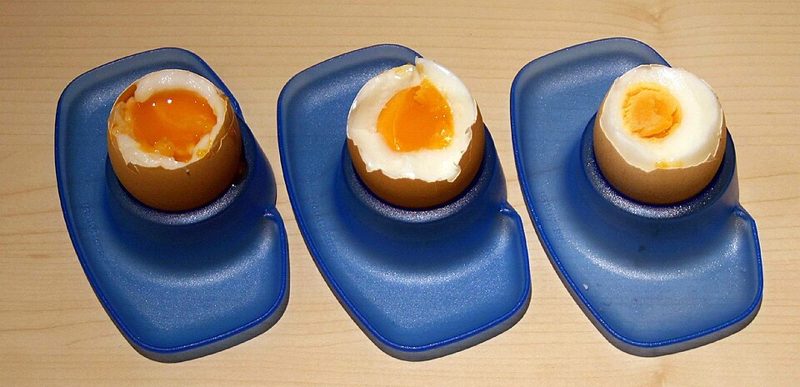
- 2 to 4 minutes: soft, runny yolk and soft white.
- 6 to 8 minutes: soft but set yolk (often called jammy) and a firm white.
- 10 to 15 minutes: fully set yolk and white.
A food safety note many recipe pages skip: USDA advises cooking eggs until both the white and yolk are firm, and says infants, young children, older adults, pregnant women and people with weakened immune systems are especially vulnerable to Salmonella from undercooked eggs. Pasteurized shell eggs are a safer choice for runny yolks (USDA FSIS).
How to boil eggs for easy peeling
The biggest factor is the age of the egg. USDA explains that the egg white has a pH of about 7.4 when the egg is laid and rises to about 9 as the egg ages, which loosens the white from the inner shell membrane (USDA FSIS). MSU Extension recommends using eggs that are at least 7 to 10 days old (MSU Extension).
- Cool the eggs completely in cold or ice water. They peel more easily once cooled because the egg contracts slightly in the shell.
- Tap the egg gently on the counter until the shell is finely cracked all over.
- Roll the egg between your hands to loosen the shell.
- Start peeling at the large end, where the air cell is, while holding the egg under cold running water.
NC State Extension advises against piercing the shell before cooking because it can create hairline cracks that let bacteria in (NC State Extension). More methods are in how to peel hard-boiled eggs easily.
Common boiled egg problems
Green or gray ring around the yolk
This is usually from overcooking. USDA says sulfur and iron compounds react on the yolk surface, and high iron in the cooking water can also cause it. The color is safe to eat (USDA FSIS). Cooling the eggs promptly in ice water helps prevent it.
Cracked shells
Eggs that crack during hard cooking are still safe, according to USDA (USDA FSIS). Lowering eggs gently and keeping them in a single layer reduces cracking.
Eggs that float
An egg floats when its air cell has grown large, which signals lower quality but not necessarily spoilage. Learn more in what it means when an egg floats in water.
How to store hard-boiled eggs safely
Hard-cooked eggs spoil faster than raw eggs because cooking leaves a thin layer of water under the shell that favors bacterial growth. USDA says to refrigerate them within 2 hours of cooking and use them within one week, and not to freeze them (USDA FSIS). Once peeled, they are best eaten the same day (NC State Extension).
Keep the refrigerator at 40°F or below. For raw egg storage times, see how long eggs last in the fridge, and for other foods, our chicken internal temperature guide covers USDA safe cooking temperatures.
Frequently asked questions
How long do you boil eggs for?
Using the American Egg Board method, bring the water to a boil, turn off the heat and let the eggs stand covered about 9 minutes for medium, 12 minutes for large and 15 minutes for extra-large eggs.
Do you put eggs in boiling water or cold water?
The American Egg Board method starts eggs in cold water, about 1 inch above the eggs, and then brings the water to a boil. Some cooks lower eggs into already boiling water instead; both work if you time them carefully.
Why are my hard-boiled eggs hard to peel?
Very fresh eggs are harder to peel. USDA explains that the egg white becomes more alkaline as an egg ages, which loosens it from the shell membrane, so eggs that are 7 to 10 days old peel more easily.
How long do hard-boiled eggs last in the fridge?
USDA says hard-cooked eggs should be refrigerated within 2 hours of cooking and used within one week. Do not freeze them.
Is the green ring on a boiled egg safe to eat?
Yes. USDA says the green ring forms when sulfur and iron compounds react on the yolk surface, usually from overcooking, and it is safe to eat.
Sources
- USDA Food Safety and Inspection Service: Shell Eggs from Farm to Table
- Michigan State University Extension: Easy hard-boiled eggs
- Michigan State University Extension: Peeling hard boiled eggs
- N.C. Cooperative Extension, Brunswick County Center: Peeling a Hard-Cooked Egg
- Allrecipes: How To Boil an Egg
Featured image: Boiled eggs cooked for 4, 7 and 9 minutes, from left to right. Photo by Wikisearcher, CC BY-SA 3.0, via Wikimedia Commons; resized.
