
Last updated: November 8, 2026
The safe chicken internal temperature is 165°F (74°C), measured with a food thermometer in the thickest part of the meat and away from bone. That same 165°F minimum applies to chicken breasts, thighs, wings, ground chicken, a whole bird and any stuffing cooked inside poultry, according to FoodSafety.gov and the USDA Food Safety and Inspection Service.
Contents
- What temperature should chicken be cooked to?
- Chicken internal temperature chart
- How to check chicken internal temperature
- Safe internal cooking temperatures for other meats
- Can chicken be pink and still be safe?
- Chicken internal temperature in Celsius
- How to handle leftover chicken safely
- Frequently asked questions
What temperature should chicken be cooked to?
Cook chicken until a food thermometer reads 165°F (74°C). FoodSafety.gov groups chicken with turkey and other poultry and applies that number to every common cut: the whole bird, breasts, legs, thighs, wings, ground poultry, giblets, sausage and stuffing placed inside a bird.
USDA FSIS states the same rule: cook all poultry to 165°F as measured with a food thermometer (Keep Food Safe! Food Safety Basics). Chicken breast, thighs and ground chicken are all safe at that same reading.
You may cook chicken hotter if you want dark meat more tender. FSIS treats “doneness” (texture, appearance and juiciness) as separate from safety, and says people may cook food above the minimum for the texture they prefer (Food Thermometers). Extra heat is a quality choice, not a second safety standard.
Chicken internal temperature chart
| Chicken cut | Safe internal temperature |
|---|---|
| Chicken breast | 165°F (74°C) |
| Chicken thighs, legs and drumsticks | 165°F (74°C) |
| Chicken wings | 165°F (74°C) |
| Whole chicken | 165°F (74°C) in the thigh, wing and breast |
| Ground chicken or chicken sausage | 165°F (74°C) |
| Giblets | 165°F (74°C) |
| Stuffing cooked inside a chicken | 165°F (74°C) in the center of the stuffing |
| Leftover chicken, reheated | 165°F (74°C) |
A whole turkey follows the same 165°F poultry rule. For a large roast, pair this check with how long to cook a turkey by weight, and thaw it first using the safe refrigerator, cold-water and microwave times.
How to check chicken internal temperature
Color, clear juices and grill marks are not reliable signs that chicken is safe. FSIS says a food thermometer is the only reliable way to confirm that meat, poultry, seafood and egg dishes have reached a safe minimum internal temperature.
- Read the thermometer’s instructions so you know how deep the sensing area must go. Many dial stems read along 2 to 3 inches; digital tip sensors read at the end of the probe.
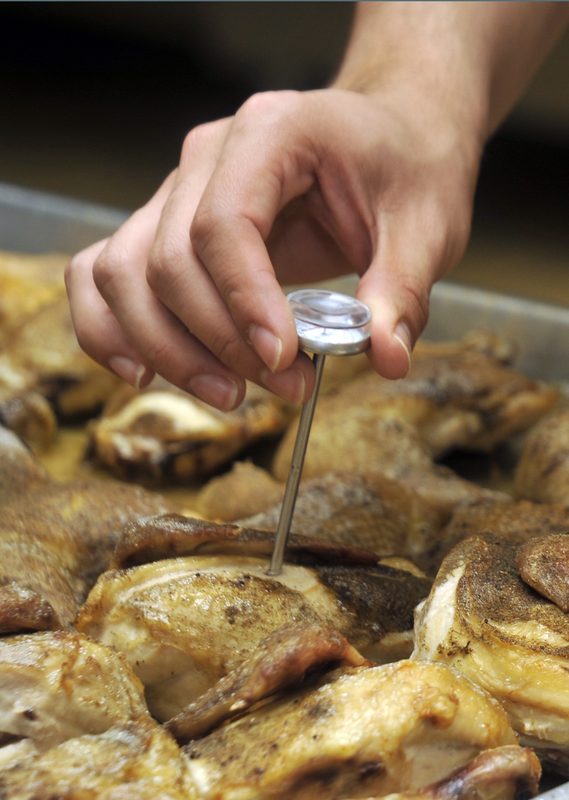
- Insert the thermometer into the thickest part of the chicken, away from bone, fat or gristle.
- For a whole chicken, check three places: the innermost thigh, the innermost wing and the thickest part of the breast. All three should reach 165°F.
- For parts such as breasts, thighs and wings, use the thickest area and avoid the bone. On a thin breast or tender, push the probe in from the side so it reaches the center.
- If you stuffed the bird, also check the center of the stuffing. It must reach 165°F. FSIS says the safest option is not to stuff whole poultry.
- Check each piece when you cook several at once, because size and pan position change how fast each piece heats.
- Wash the thermometer with hot, soapy water after each use.
Safe internal cooking temperatures for other meats
The FoodSafety.gov chart, last reviewed November 21, 2024, lists these consumer temperatures alongside chicken:
| Food | Type | Minimum internal temperature |
|---|---|---|
| Beef, bison, veal, goat and lamb | Steaks, roasts and chops | 145°F (63°C), then rest 3 minutes |
| Beef, bison, veal, goat and lamb | Ground meat and sausage | 160°F (71°C) |
| Pork | Steaks, roasts and chops | 145°F (63°C), then rest 3 minutes |
| Pork | Ground meat and sausage | 160°F (71°C) |
| Chicken, turkey and other poultry | All cuts, ground poultry, giblets and stuffing inside the bird | 165°F (74°C) |
| Ham | Raw ham | 145°F (63°C), then rest 3 minutes |
| Ham | Precooked ham, reheated | 165°F (74°C); 140°F (60°C) if packaged in a USDA-inspected plant |
| Eggs | Egg dishes such as frittata or quiche | 160°F (71°C) |
| Seafood | Fish | 145°F (63°C), or until the flesh is no longer translucent and separates easily with a fork |
| Leftovers and casseroles | Any type | 165°F (74°C) |
| Rabbit and venison | Wild or farm-raised | 160°F (71°C) |
The 3-minute rest after 145°F applies to intact steaks, chops, roasts and raw ham. Poultry that has already reached 165°F does not have a separate required rest time on that chart.
For cook times once the thermometer hits the right number, see what temperature pork should be cooked to, how to cook a ham, including internal temperatures, and how to cook prime rib by weight.
Can chicken be pink and still be safe?
Yes, if a thermometer shows 165°F. FSIS says the color of cooked poultry is not a sure sign of safety, and that poultry can remain pink even after it reaches 165°F. Smoked poultry is typically pink, and grilled meat can show a pink rim about half an inch wide and still be fully cooked (Is Pink Turkey Meat Safe?).
Pink color can come from oven gases, myoglobin, a young bird’s thinner skin, or smoke. Food can also brown before it is safe: a USDA study cited by FSIS found that 21% of participants judged hamburger doneness by color or grill marks.
Chicken internal temperature in Celsius
FoodSafety.gov lists the poultry minimum as 165°F (74°C). Use 74°C for chicken breasts, thighs, wings, ground chicken and stuffing. The same chart lists 145°F as 63°C and 160°F as 71°C. To convert other probe readings, see the Celsius to Fahrenheit formula and conversion chart.
How to handle leftover chicken safely
Reheat leftover chicken to 165°F (74°C). Refrigerate or freeze it within 2 hours, or within 1 hour if the food has been sitting where the air is above 90°F. FSIS says most cooked leftovers keep 3 to 4 days in a refrigerator at 40°F or below.
The CDC advises against washing raw chicken before you cook it, because rinsing can splash germs around the sink. A USDA study cited by the CDC found that 1 in 7 people who cleaned their sink after washing chicken still had germs in the sink. Keep raw juices away from ready-to-eat foods, and wash your hands with soap and water for at least 20 seconds before and after handling chicken (CDC, Chicken and Food Poisoning).
Frequently asked questions
What temperature should chicken be cooked to?
Cook chicken to a safe minimum internal temperature of 165°F (74°C), checked with a food thermometer in the thickest part of the meat and away from bone.
What temperature should chicken breast be cooked to?
Chicken breast is done and safe at 165°F (74°C). Insert the thermometer into the thickest part of the breast; for a thin cut, insert it through the side so the tip reaches the center.
What temperature should chicken thighs be cooked to?
The USDA safe minimum for chicken thighs, legs and wings is the same 165°F (74°C) as for breasts and ground chicken. You may cook dark meat hotter if you prefer a softer texture.
Can chicken be pink and still be safe?
Yes. The USDA says the color of cooked poultry is not a reliable safety test. Poultry can stay pink after it reaches 165°F, especially near the bone, in young birds, or after grilling or smoking. Use a thermometer.
Where do you put the thermometer in a chicken?
For a whole chicken, check the innermost thigh, the innermost wing and the thickest part of the breast, avoiding bone. For parts, use the thickest area away from bone. For thin pieces, insert the thermometer sideways into the center.
What is the chicken internal temperature in Celsius?
FoodSafety.gov lists 165°F as 74°C. That Celsius figure is the same for every chicken cut, ground chicken and stuffing cooked inside a bird.
Sources
- FoodSafety.gov — Cook to a Safe Minimum Internal Temperature
- USDA FSIS — Keep Food Safe! Food Safety Basics
- USDA FSIS — Food Thermometers
- USDA FSIS — Is Pink Turkey Meat Safe?
- CDC — Chicken and Food Poisoning
Featured image: a cook checks baked chicken with a food thermometer. U.S. Air Force photo by Airman 1st Class Zachary Kee, public domain, via Wikimedia Commons.