
Last updated: November 17, 2026
To convert liters to gallons, divide the number of liters by 3.785 (or multiply by 0.264) to get U.S. gallons. For UK imperial gallons, divide by 4.546 instead. For example, 10 liters equals about 2.64 U.S. gallons or 2.20 imperial gallons.
This guide gives the exact formula, a liters to gallons conversion chart, the difference between U.S. and imperial gallons, and quick ways to convert fuel and water bottle sizes in your head.
Contents
- What is the liters to gallons formula?
- How to convert liters to gallons step by step
- Liters to gallons conversion chart
- US gallons vs. UK imperial gallons vs. dry gallons
- Liters to gallons for gas, water and fuel economy
- How to estimate liters to gallons in your head
- Frequently asked questions
What is the liters to gallons formula?
NIST, the U.S. National Institute of Standards and Technology, lists one U.S. liquid gallon as 3.785 412 liters and one imperial gallon (used in the United Kingdom and historically in Canada) as 4.546 09 liters (NIST Special Publication 811, Appendix B.9). UK law defines the gallon as exactly 4.54609 cubic decimetres, and a cubic decimetre is the same as a liter (Weights and Measures Act 1985, Schedule 1; NIST).
- U.S. gallons = liters ÷ 3.785412 (or liters × 0.264172)
- Imperial gallons = liters ÷ 4.54609 (or liters × 0.219969)
- Liters = U.S. gallons × 3.785412
Natural Resources Canada uses the same factors for energy statistics: multiply liters by 0.264172052 to get U.S. gallons, and U.S. gallons by 3.78541178 to get liters (Natural Resources Canada).
How to convert liters to gallons step by step
- Confirm which gallon you need. Use the U.S. gallon for prices, recipes and labels in the United States, and the imperial gallon for older UK fuel figures and UK-published specifications.
- Write down the liters. Convert milliliters first by dividing by 1,000, because 1,000 mL equals 1 L (NIST).
- Divide by the gallon size. Divide by 3.785412 for U.S. gallons or by 4.54609 for imperial gallons.
- Round for the job. Two decimal places are enough for fuel, aquariums and cooking; keep more digits for lab or engineering work.
Example: a 60-liter fuel tank holds 60 ÷ 3.785412 = 15.85 U.S. gallons, or 60 ÷ 4.54609 = 13.20 imperial gallons.
Liters to gallons conversion chart
Values below are calculated from the NIST factors and rounded to two decimal places.
| Liters | U.S. gallons | Imperial (UK) gallons |
|---|---|---|
| 0.5 L | 0.13 | 0.11 |
| 1 L | 0.26 | 0.22 |
| 1.5 L | 0.40 | 0.33 |
| 2 L | 0.53 | 0.44 |
| 3 L | 0.79 | 0.66 |
| 4 L | 1.06 | 0.88 |
| 5 L | 1.32 | 1.10 |
| 10 L | 2.64 | 2.20 |
| 15 L | 3.96 | 3.30 |
| 19 L | 5.02 | 4.18 |
| 20 L | 5.28 | 4.40 |
| 25 L | 6.60 | 5.50 |
| 40 L | 10.57 | 8.80 |
| 50 L | 13.21 | 11.00 |
| 60 L | 15.85 | 13.20 |
| 100 L | 26.42 | 22.00 |
| 200 L | 52.83 | 43.99 |
| 1,000 L | 264.17 | 219.97 |
Gallons to liters
Going the other way: 1 U.S. gallon = 3.79 L, 2 gallons = 7.57 L, 5 gallons = 18.93 L, 10 gallons = 37.85 L and 20 gallons = 75.71 L. Smaller U.S. units follow the same pattern: a liquid quart is 0.946 L and a liquid pint is 0.473 L (NIST). See also how many quarts are in a gallon.
US gallons vs. UK imperial gallons vs. dry gallons
The word “gallon” covers three different volumes, which is the most common cause of conversion mistakes.
| Unit | Liters per gallon | Where it is used |
|---|---|---|
| U.S. liquid gallon | 3.785412 | United States: milk, fuel, paint, water |
| Imperial gallon | 4.54609 (exact) | United Kingdom and older Canadian figures |
| U.S. dry gallon | about 4.404884 (4 dry quarts) | Rarely used; dry produce measures such as pecks and bushels |
An imperial gallon is about 1.20 U.S. gallons, or roughly 20 percent larger. The U.S. dry gallon figure is four times NIST’s U.S. dry quart of 1.101 221 liters (NIST). Unless a label says otherwise, a U.S. gallon means the liquid gallon.
Liters to gallons for gas, water and fuel economy
Water bottles and jugs
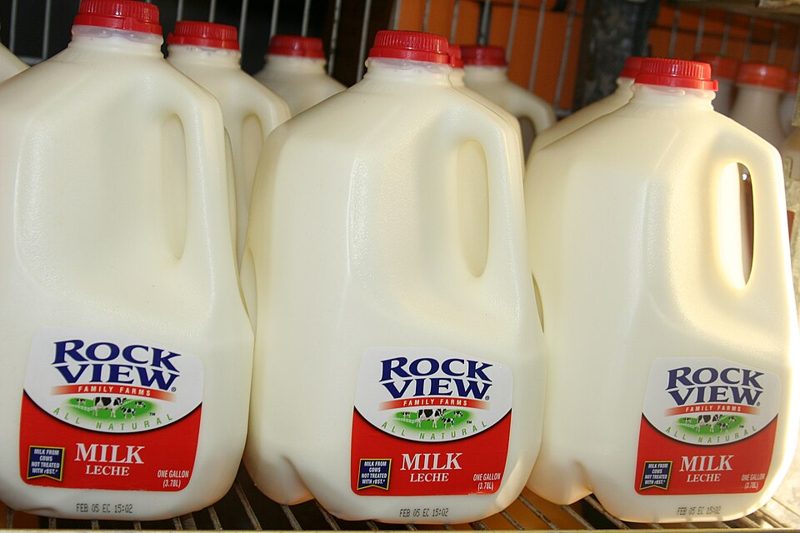
A 1-liter bottle holds about 0.26 U.S. gallons, or 33.8 U.S. fluid ounces, using NIST’s factor of 29.57 mL per fluid ounce (NIST). A 19-liter water cooler jug is about 5.02 U.S. gallons, which is why it is sold as a 5-gallon jug. A standard U.S. milk jug holds one gallon, labeled as 3.78 L. For drinks measured in cups, see how many ounces are in a cup and our cooking conversion chart for cups, spoons, ounces and grams.
Gas and fuel tanks
To compare a price per liter with a price per U.S. gallon, multiply the per-liter price by 3.785. A car rented abroad with a 50-liter tank holds about 13.21 U.S. gallons.
Converting fuel economy (mpg to L/100 km)
Fuel economy uses the inverse unit. NIST’s rule is to divide 235.215 by miles per U.S. gallon to get liters per 100 kilometers (NIST). So 30 mpg is about 7.8 L/100 km, and 40 mpg is about 5.9 L/100 km. For the distance part of that math, see our km to miles conversion guide.
How to estimate liters to gallons in your head
- Divide by 4, then add 5 percent. 40 L ÷ 4 = 10, plus 5 percent is 10.5; the exact answer is 10.57 U.S. gallons.
- Use the label rule. NIST’s quick-reference table rounds one gallon to 3.79 liters and one liquid quart to 0.95 liter (NIST approximate conversions), so 4 liters is just over a gallon.
- For imperial gallons, divide by 4.5. 45 L ÷ 4.5 = 10 imperial gallons (exact: 9.90).
Traveling with liquids? Carry-on limits are set in milliliters, which our guide to the TSA 3-1-1 liquid rules explains. For weights, see lbs to kg with a conversion chart.
Frequently asked questions
How many liters is 1 gallon?
One U.S. liquid gallon is about 3.785 liters (3.785412 L in NIST’s table). One imperial gallon, used in the United Kingdom, is exactly 4.54609 liters.
Is 1 liter half a gallon?
No. One liter is about 0.264 U.S. gallons, or roughly a quarter of a gallon. Half a U.S. gallon is about 1.89 liters.
Is 4 liters equal to 1 gallon?
Not exactly. Four liters is about 1.057 U.S. gallons, so it is slightly more than one gallon. One U.S. gallon is about 3.785 liters.
How many gallons is 20 liters?
Twenty liters is about 5.28 U.S. gallons or about 4.40 imperial gallons.
How many liters of water make a gallon?
About 3.785 liters of water fill one U.S. gallon. The conversion is the same for water, milk, gasoline or any other liquid because it measures volume, not weight.
What is the difference between a US gallon and a UK gallon?
A U.S. liquid gallon is about 3.785 liters, while a UK (imperial) gallon is exactly 4.54609 liters, so the imperial gallon is about 20 percent larger.
Sources
- NIST Special Publication 811, Appendix B.9: Factors for Units Listed by Kind of Quantity
- NIST Office of Weights and Measures: Approximate Conversions from U.S. Customary Measures to Metric
- NIST Office of Weights and Measures: SI Units of Volume
- UK Weights and Measures Act 1985, Schedule 1 (legislation.gov.uk)
- Natural Resources Canada: Conversion Factors and Common Units for North American Energy Information
Featured image: “Milk jugs in a row” by ChildofMidnight, CC BY-SA 3.0, via Wikimedia Commons; resized.
