
Last updated: October 27, 2026
This cooking conversion chart covers the kitchen measurements US recipes use most. One cup equals 16 tablespoons, 48 teaspoons, 8 fluid ounces or about 240 mL; one tablespoon equals 3 teaspoons or about 15 mL. For dry ingredients, weight in grams depends on the ingredient, so use the cups-to-grams table below.
All figures come from the National Institute of Standards and Technology (NIST) and the U.S. Food and Drug Administration (FDA). Metric values are rounded for home cooking.
Contents
- Cooking conversion chart for cups, spoons and mL
- How many tablespoons are in a cup?
- Pints, quarts and gallons
- Cups to grams by ingredient
- Ounces and pounds to grams
- Oven temperature conversion chart
- How to measure ingredients accurately
- Frequently asked questions
Cooking conversion chart for cups, spoons and mL
The table uses the US customary units in NIST’s Household Weights and Measures card (SP 430) and the rounded metric equivalents on its Metric Kitchen cooking measurement equivalencies page.
| US measure | Equals | Fluid ounces | Metric (approx.) |
|---|---|---|---|
| 1/4 teaspoon | – | – | 1.25 mL |
| 1/2 teaspoon | – | – | 2.5 mL |
| 1 teaspoon | 1/3 tablespoon | 1/6 fl oz | 5 mL |
| 1 tablespoon | 3 teaspoons | 1/2 fl oz | 15 mL |
| 1/8 cup | 2 tablespoons | 1 fl oz | 30 mL |
| 1/4 cup | 4 tablespoons | 2 fl oz | 60 mL |
| 1/3 cup | 5 tablespoons + 1 teaspoon | 2 2/3 fl oz | 80 mL |
| 1/2 cup | 8 tablespoons | 4 fl oz | 120 mL |
| 3/4 cup | 12 tablespoons | 6 fl oz | 180 mL |
| 1 cup | 16 tablespoons (48 teaspoons) | 8 fl oz | 240 mL |
The FDA uses the same rounded values on food labels. Its guidance on metric equivalents of household measures states that for nutrition labeling, 1 cup means 240 mL, 1 tablespoon 15 mL, 1 teaspoon 5 mL and 1 fluid ounce 30 mL. More precise figures from NIST are 4.93 mL per teaspoon, 14.79 mL per tablespoon and 29.57 mL per fluid ounce. For a single answer, see how many teaspoons are in a tablespoon.
US cup vs. metric cup
NIST SP 430 gives the US customary cup as about 237 mL and the metric cup used in many other countries as 250 mL. A US recipe made with metric cups yields only about 5% more, so the two can usually be swapped as long as you use the same set for the whole recipe.
How many tablespoons are in a cup?
There are 16 tablespoons in a cup. To scale a recipe up or down, use these steps:
- Convert to tablespoons. Multiply cups by 16. For example, 3/4 cup × 16 = 12 tablespoons.
- Scale the amount. Halving 12 tablespoons gives 6 tablespoons.
- Convert back if you want. Divide by 16 for cups (6 ÷ 16 = 3/8 cup), or measure 6 tablespoons directly.
- Handle leftovers in teaspoons. Any fraction of a tablespoon converts at 3 teaspoons per tablespoon, so 1/3 tablespoon is 1 teaspoon.
The same math answers how many ounces are in a cup: 16 tablespoons at 1/2 fluid ounce each is 8 fluid ounces.
Pints, quarts and gallons
For larger liquid amounts, NIST lists these equivalents:
- 1 pint = 2 cups = 16 fluid ounces = about 480 mL
- 1 quart = 2 pints = 4 cups = 32 fluid ounces = about 950 mL
- 1/2 gallon = 2 quarts = 8 cups = 64 fluid ounces = about 1.95 L
- 1 gallon = 4 quarts = 16 cups = 128 fluid ounces = about 3.8 L
- 1 liter = about 34 fluid ounces, 4.2 cups or 1.06 quarts
These are liquid measures. NIST notes that a US dry quart is about 16% larger than a liquid quart, which matters for produce sold by the dry pint or quart. More detail is in how many quarts are in a gallon.
Cups to grams by ingredient
A cup measures volume, so its weight depends on the ingredient. NIST SP 430 lists these approximate weights per US cup:
| Ingredient (1 cup) | Grams | Ounces by weight |
|---|---|---|
| All-purpose wheat flour | 113 g | 4 oz |
| Cake flour, sifted | 99 g | 3 1/2 oz |
| Granulated sugar | 198 g | 7 oz |
| Brown sugar, firmly packed | 213 g | 7 1/2 oz |
| Butter, margarine or cooking oil | 227 g | 8 oz |
| Water | 236 g | 8 1/3 oz |
| Whole milk | 241 g | 8 1/2 oz |
| Rice (uncooked) | 198 g | 7 oz |
| Oatmeal | 85 g | 3 oz |
| Corn meal | 142 g | 5 oz |
| Raisins, seedless | 142 g | 5 oz |
| Pecans | 113 g | 4 oz |
Other references give different numbers, for example around 120 g for a cup of flour, because the result depends on whether the cup is scooped, spooned or sifted. Butter is easy: Good Housekeeping’s kitchen equivalents chart puts one US stick at 8 tablespoons or 4 ounces, which is 1/2 cup and about 113 g by the NIST figure.
Ounces and pounds to grams
Weight ounces are not the same as fluid ounces. NIST’s metric conversion card (SP 365) gives 1 ounce as 28.35 g and 1 pound as 0.45 kg. Rounded for the kitchen:
- 1 ounce = about 28 g
- 4 ounces (1/4 pound) = about 114 g
- 8 ounces (1/2 pound) = about 227 g
- 16 ounces (1 pound) = about 454 g
- 1 kilogram (1,000 g) = about 2.2 pounds
A cup of water weighs about 8 1/3 ounces, while a cup of flour weighs only about 4 ounces, so never swap fluid ounces for weight ounces with dry ingredients. See also how many ounces are in a pound.
Oven temperature conversion chart
To convert Fahrenheit to Celsius, NIST SP 365 says to subtract 32 and divide by 1.8. The table rounds to the nearest degree; recipes often round further to the nearest 5 or 10 degrees.
| Fahrenheit | Celsius (approx.) |
|---|---|
| 250 °F | 121 °C |
| 275 °F | 135 °C |
| 300 °F | 149 °C |
| 325 °F | 163 °C |
| 350 °F | 177 °C |
| 375 °F | 191 °C |
| 400 °F | 204 °C |
| 425 °F | 218 °C |
| 450 °F | 232 °C |
| 475 °F | 246 °C |
For any other temperature, our Celsius to Fahrenheit conversion guide has the reverse formula and a full chart. For roasting times, see how long to cook a turkey.
How to measure ingredients accurately
NIST’s culinary measurement tips recommend these habits:
- Weigh when you can. Measuring by mass on a kitchen scale is more accurate than measuring by volume.
- Use the right cup. Use dry measuring cups for dry ingredients and fluid measuring cups for liquids.
- Level dry ingredients. Strike off the excess across the top of the cup.
- Read liquids at eye level. Set the fluid measuring cup on a level surface and read the meniscus at eye level.
- Convert old recipes by weighing. Measure the ingredient with the original tool, then weigh it in grams.
- Check your thermometer. Boiling water should read 100 °C (212 °F) at sea level; adjust for any difference.
Frequently asked questions
How many tablespoons are in a cup?
There are 16 tablespoons in 1 US cup. That means 1/2 cup is 8 tablespoons and 1/4 cup is 4 tablespoons.
How many ounces are in a cup?
One US cup holds 8 fluid ounces, or about 240 mL. Fluid ounces measure volume, so a cup of an ingredient can weigh more or less than 8 ounces.
How many teaspoons are in a tablespoon?
There are 3 teaspoons in 1 tablespoon. One teaspoon is about 5 mL and one tablespoon is about 15 mL.
How many grams are in a cup of flour?
NIST lists 1 cup of all-purpose wheat flour at about 113 grams. The weight changes with how the flour is scooped or packed, so a kitchen scale gives the most consistent results.
What is 350 degrees Fahrenheit in Celsius?
350 °F is about 177 °C. Subtract 32 from the Fahrenheit temperature and divide by 1.8; many recipes round this to 175 or 180 °C.
Is a dry cup the same as a liquid cup?
A recipe cup is the same 8-fluid-ounce unit for dry and liquid ingredients, but the measuring tools differ. NIST says using a dry measuring cup for liquids, or the reverse, is a common cause of measuring errors.
Sources
- NIST: Metric Kitchen, Cooking Measurement Equivalencies
- NIST SP 430: Household Weights and Measures (PDF)
- NIST: Metric Kitchen, Culinary Measurement Tips
- NIST SP 365: Metric Conversion Card (PDF)
- FDA: Guidelines for Determining Metric Equivalents of Household Measures
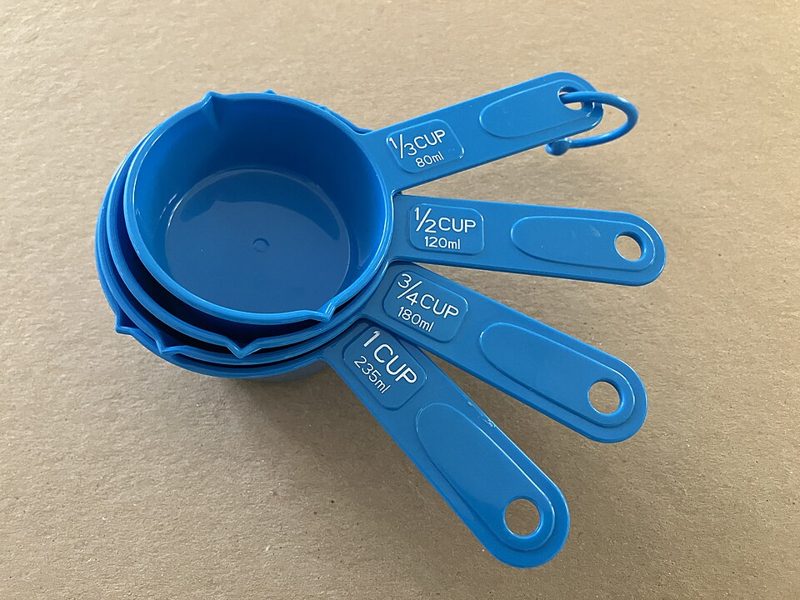
Image: “Measuring Cups.jpg,” by Estabiano, CC0 (public domain dedication), via Wikimedia Commons. Resized.
