
Last updated: November 28, 2026
Here is how to ice skate as a beginner: wear snug, well-laced skates, bend your knees, hold your arms out in front of you, and take small marching steps along the boards. Then march and glide on two feet, push off the inside edge of each blade, and learn the snowplow stop and how to fall safely.
The steps below follow advice from Learn to Skate USA and a professional skating instructor, plus ice safety rules for skating outdoors.
Contents
- What to wear ice skating
- How to choose and lace ice skates
- How to ice skate for beginners, step by step
- How to stop on ice skates
- How to fall and get back up
- How to ice skate backwards
- Is outdoor ice safe to skate on?
- Frequently asked questions
What to wear ice skating
Learn to Skate USA notes that rinks keep thermostats at about 50°F and recommends plenty of layers with a jacket, plus sweatpants or warm-up pants rather than bulky snow pants (Learn to Skate USA first-day guide). Instructor Wyoma, in L.L.Bean’s beginner guide, adds that skaters sweat more than expected, so use light layers.
- Helmet: Learn to Skate USA says all beginning skaters should wear one, such as a helmet certified to ASTM F1447 or Snell B-90A, B-95 or N-94.
- Gloves or mittens: they protect your hands as you learn to fall and stand back up.
- Socks: one pair of thin socks or tights. Thick socks limit support and create uncomfortable bumps inside the boot.
How to choose and lace ice skates
The two common types are figure skates and hockey skates. According to L.L.Bean, figure skate blades are generally longer, which gives more contact with the ice and can mean better balance for a beginner. Hockey skate blades are shorter and built for quick turns and acceleration.
How tight should ice skates be?
Learn to Skate USA’s rule of thumb is that the closer the fit, the more control. Boots should be snug, with just enough room to wiggle your toes and your heel far back in the boot. Shoe size does not necessarily match skate size, so try on pairs until one feels right.
How to lace skates
- Tap your heel back into the boot and pull the tongue straight up.
- Pull the lower laces tight so the boot closes well over the front of your foot.
- Keep the laces snug through the ankle, where support matters most. The top two hooks can be a little looser so the ankle can flex.
- Tuck in extra lace; loose, flying bows often lead to accidents.
- Test the fit: you should be able to slide a finger between the back of the boot and your leg. If anything hurts, relace.
How to ice skate for beginners, step by step
Learn to Skate USA teaches marching first, then falling and standing back up. Its six-level Basic Skills curriculum then builds forward and backward skating, stops, edges and turns. Here is the beginner sequence from instructor Wyoma:
- Find your stance. Step on near the boards. Bend your knees and hold your hands out as if they were resting flat on a table in front of you.
- March. Take small marching steps, barely lifting your feet off the ice, with your knees bent.
- Glide on two feet. March a few steps, bring your skates together, and let them glide: march, march, march, glide.
- Try a one-foot glide. After a two-foot glide, lift one toe up toward the heel of your skating foot and balance as long as you can.
- Do swizzles. With heels together and knees bent, draw small circles with the insides of your blades to bring your toes together, then repeat to move forward.
- Start stroking. Turn one skate slightly outward, push off its inside edge and glide on the other skate, then switch feet. In figure skates, avoid pushing off the toe pick.
Leg strength from proper squats and core exercises like the plank helps with bent-knee balance.
How to stop on ice skates
The snowplow stop is the first stop most beginners learn. L.L.Bean’s guide describes it this way:
- Practice at the boards first. Start with your feet together and knees bent.
- Point your toes slightly inward.
- Press your skates outward so the blades scrape the top layer of the ice. This should bring you to a stop.
- Then try it away from the boards with more speed, on two feet or one.
How to fall and get back up
Everyone falls. Learn to Skate USA points out that even Olympic medalists have fallen hundreds of times. If you feel yourself losing balance, bring your arms out in front, bend your knees as much as you can to get closer to the ice, and relax into a fall to one side (L.L.Bean).
To get up, roll onto your knees, bring one leg forward with that foot flat, place one hand on your knee and the other (gloved) hand on the ice, and press up to standing.
How to ice skate backwards
Once you are steady going forward, try Wyoma’s “rocking horse” drill: start with heels together and arms out, bend your knees, and draw a small circle with the insides of your skates to bring your toes together, which moves you forward. Then reverse the circle to bring your heels together, which moves you backward. Repeat the backward half to build backward swizzles, looking over your shoulder.
Is outdoor ice safe to skate on?
Ice on ponds and lakes is never 100% safe, according to the Minnesota Department of Natural Resources, and it can be two feet thick in one place and one inch thick a few yards away.
| New, clear ice thickness | Minnesota DNR guideline |
|---|---|
| Under 4 inches | Stay off |
| 4 inches | Ice fishing or other activities on foot |
| White (snow) ice | About half as strong as new, clear ice, so double the guideline |
Before skating on natural ice, the DNR’s ice travel guidance says to tell someone where you are going and when you will return, measure the ice, wear a foam life jacket or other buoyant gear, and carry ice picks you can reach. See also how snowflakes form and how many steps a day you need.
Frequently asked questions
Should ice skates be a size smaller than your shoes?
Often, yes. L.L.Bean’s guide says you may need to try skates 1 to 1.5 sizes down from your shoe size, though this varies by maker, and Learn to Skate USA notes that shoe size does not necessarily match skate size, so always try skates on.
Are figure skates or hockey skates better for beginners?
Either works. Figure skate blades are generally longer, which gives more contact with the ice and can mean better balance for a beginner, while hockey skates have shorter blades built for quick turns and acceleration.
What should you wear ice skating for the first time?
Wear warm, light layers you can remove, pants that let you move freely, gloves or mittens to protect your hands when you fall, and one pair of thin socks. Learn to Skate USA recommends a helmet for all beginning skaters.
How do you stop on ice skates as a beginner?
Use the snowplow stop. Bend your knees, point your toes slightly inward, and push your skates outward so the blades scrape the top layer of the ice until you slow to a stop.
How thick does ice need to be to skate on?
The Minnesota DNR recommends waiting for at least 4 inches of new, clear ice before going out on foot, and doubling that guideline for white ice. Ice is never 100% safe, and thickness can vary across the same pond.
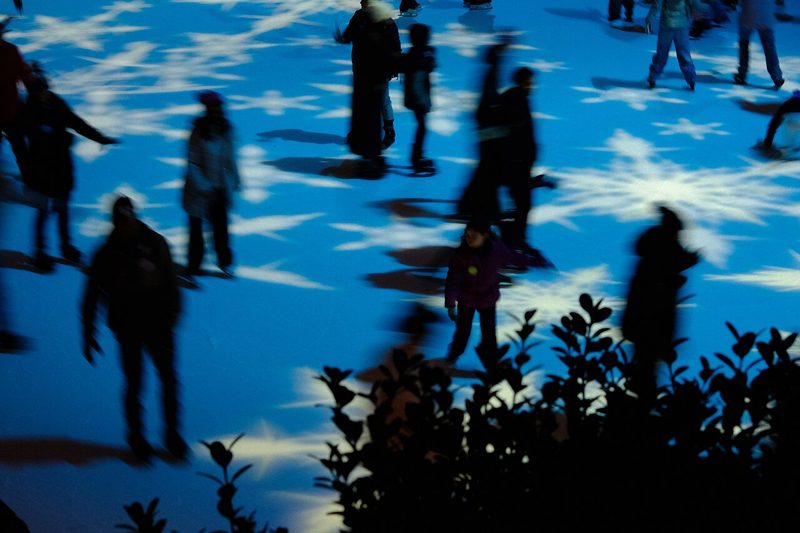
Featured image: “Ice skating rink – Rockefeller center” by Annanaïg, via Wikimedia Commons, released under CC0; resized. This guide is general information; follow your rink’s rules and local ice safety advice.

Sources
- Learn to Skate USA: The First Day of Skating (PDF)
- Learn to Skate USA: Basic Skills curriculum
- L.L.Bean: Ice Skating Tips for Beginners
- Minnesota DNR: General ice thickness guidelines
- Minnesota DNR: Traveling on ice