
Last updated: November 23, 2026
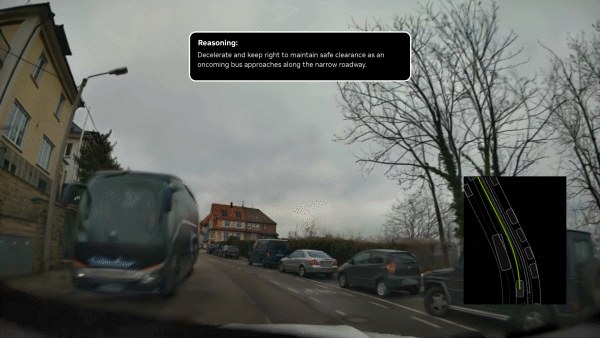
Alpamayo 2 Edge is NVIDIA’s 2B-parameter open driving model, released November 10, 2026. It reads six camera feeds, recent vehicle motion and a navigation instruction, then writes a short reasoning trace and plans a 6.4-second trajectory. It runs on a 16 GB GPU and, once optimized, in about 160 to 190 ms on DRIVE AGX Thor.
Contents
- What Alpamayo 2 Edge is
- Key specifications
- How to run it on a workstation GPU
- Deploying on DRIVE AGX Thor
- Benchmarks and comparisons
- Limitations and license
- Frequently asked questions
What Alpamayo 2 Edge is
Alpamayo 2 Edge is a vision-language-action (VLA) model: one network that looks at the road, explains its decision in text and outputs a path for the vehicle. NVIDIA introduced it in a technical blog post on November 10, 2026, and the weights went up on Hugging Face the same day. It is part of the Alpamayo Open Platform, which NVIDIA describes as two open models: Alpamayo 2 Edge, a 2B model for in-car reasoning, and Alpamayo 2 Super, a 34B foundation model for planning, auto-labeling and evaluation.
According to NVIDIA, the main new features are:
- A 2B Nemotron-based backbone taken from NVIDIA Cosmos 3 Edge, paired with a diffusion action expert that produces the trajectory.
- Adaptive reasoning. The model writes a Chain-of-Causation (CoC) explanation only when a scene calls for it. In routine driving it emits a special
<NOMINAL>token instead, which saves compute. - Distillation from Alpamayo 2 Super, which generated the reasoning labels used in training.
- Closed-loop reinforcement learning in AlpaGym, where the model learns from the results of its own actions in simulation.
- DFlash2 speculative decoding and TensorRT recipes for real-time use on the car computer.
NVIDIA also released AlpaJudge, a human-calibrated model that scores reasoning traces. The blog shows how to use it to evaluate Edge outputs, select training data and supply a reward signal for post-training.
Key specifications
The figures below come from the model card and the GitHub repository.
| Item | Alpamayo 2 Edge |
|---|---|
| Release | Hugging Face, November 10, 2026 |
| Parameters | 2.45B backbone (1.96B language model, 0.41B SigLIP2 vision encoder, 0.08B projector) plus 0.2B action expert |
| Inputs | 22 frames from six cameras, 20 past ego poses, a text navigation instruction |
| Outputs | Chain-of-Causation text (or visual question answers) and 64 waypoints from 0.1 to 6.4 seconds |
| Weights | BF16, about 5.3 GB on disk |
| Recommended GPU memory | At least 16 GB; tested on one H100 80GB |
| Software | Linux, Python 3.12, PyTorch 2.8.0, Transformers 5.17.0 |
| License | Weights: OpenMDW-1.1; code: Apache 2.0 |
The camera schedule is fixed. The front wide and front telephoto cameras each contribute five frames, at −2, −1, −0.5, −0.1 and 0 seconds. The four side and rear cameras each contribute three frames, at −1, −0.1 and 0 seconds. Custom data must match this profile.
How to run it on a workstation GPU
These steps follow the alpamayo2-edge repository README. They run NVIDIA’s public navigation example, which uses a clip from the PhysicalAI-Autonomous-Vehicles dataset with the instruction “Turn right in 30m”.
- Check the prerequisites. You need a Linux host with an NVIDIA GPU that supports BF16, Python 3.12, and the
uvpackage manager. - Accept the dataset terms. On Hugging Face, accept the access terms for the PhysicalAI-Autonomous-Vehicles dataset.
- Clone the repository and install. From the repository root, set
UV_PROJECT_ENVIRONMENT=.venv, then runuv sync --locked --extra dataset --devand activate.venv. - Sign in. Run
hf auth login, or set an existingHF_TOKEN. - Run the example. Use
python -m alpamayo2_edge.inference --model-id nvidia/Alpamayo2-Edge --manifest examples/nav_samples.json --output outputs/physicalai-nav. The README also pins an immutable--revisionfor reproducible runs. - Read the results. Each sample folder holds
output.jsonwith the decoded reasoning andoutput.safetensorswith the predicted positions and rotations.report.jsonrecords the runtime versions and sampling settings. - Try more candidates. Add
--num-traj-sets 1 --num-traj-samples 6to produce six independent trajectories, each with its own reasoning.
The default attention backend is PyTorch SDPA. If you install the optional FlashAttention 2.8.3 extra, you can add --accel tuned, which uses torch.compile and CUDA graphs. The README warns that the first call for each new input shape compiles graphs, so warm the model up before timing it.
Deploying on DRIVE AGX Thor
The BF16 checkpoint runs as an ordinary PyTorch model on supported NVIDIA GPUs, but real-time use in a vehicle needs further optimization. NVIDIA’s alpamayo-recipes deployment recipe stages the checkpoint and the DFlash2 drafter, calibrates FP8 scales, exports ONNX graphs, builds TensorRT engines with TensorRT Edge-LLM plugins and runs a Python harness. The blog says the reference setup was DRIVE AGX Thor-X with DRIVE OS 7.2.7.0, CUDA 13.4 and TensorRT 11.3.1.9.
NVIDIA reports 160 to 190 ms from pixels to trajectory, depending on how much reasoning the model writes. The recipe itself lists indicative per-stage timings and stresses that they are not a benchmark:
| Stage (FP8, six candidates) | Approximate time |
|---|---|
| Vision encoder, six newest frames | 20 ms |
| Prefill | 75 ms |
| Reasoning, per drafter round | 12 ms |
| Action expert, 5 steps × 6 candidates | 70 ms |
| Total, ten internal clips | About 180 to 250 ms per request |
Benchmarks and comparisons
The model card lists a Lingo-Judge score of 75.2 on LingoQA, 15.15 km driven per at-fault incident across 875 AlpaSim scenarios, and an open-loop minADE6 at 5 seconds of 0.52 m on 1,392 PhysicalAI-AV samples. The blog compares Edge with Qwen-Drive-1.0, a 4B model, and says Edge achieves about 60 times the distance between at-fault incidents in AlpaSim.
Early partner quotes in the blog are vendor-selected, but they give a sense of the jump from the previous generation. PORT, testing on its own London street recordings, said Edge kept its lane in more than twice as many runs as Alpamayo 1.5. Embedl said it ran the model at 10 Hz on AGX Thor in under 48 hours.
For other recent NVIDIA open-model releases, see our guides to Nemotron-Labs-Sigma diffusion language models and Nemotron for Science post-training. The larger sibling, Alpamayo 2 Super, is among the models covered in our vLLM 0.33 release guide.
Limitations and license
- Research starting point, not a driving system. NVIDIA positions Edge as a base for fine-tuning and deployment, and the model card says integration requires use-case-specific testing and validation at unit and system level.
- Limited hardware validation. Only the H100 80GB has been tested for the PyTorch path.
- Fixed sensor profile. Inputs must follow the six-camera, 22-frame schedule, and the loader requires a non-empty navigation instruction.
Frequently asked questions
What is NVIDIA Alpamayo 2 Edge?
Alpamayo 2 Edge is a 2B-parameter open vision-language-action model for autonomous driving, released on Hugging Face on November 10, 2026. It takes surround-camera video, ego-motion history and a navigation instruction, and returns a written driving rationale plus 64 future trajectory waypoints.
How is Alpamayo 2 Edge different from Alpamayo 2 Super?
Alpamayo 2 Super is NVIDIA’s 34B reasoning foundation model for planning, auto-labeling and evaluation. Alpamayo 2 Edge is the compact in-vehicle model. It was trained in part on reasoning labels generated by Alpamayo 2 Super and is sized to run on NVIDIA DRIVE AGX Thor.
What GPU do I need to run Alpamayo 2 Edge?
The model card recommends at least 16 GB of GPU memory for the provided BF16 examples. NVIDIA tested on one H100 80GB, where six trajectory candidates peaked at about 12 GiB of process memory. Other GPUs have not been validated, and the code requires Linux and Python 3.12.
Can Alpamayo 2 Edge be used commercially?
The weights are released under the OpenMDW-1.1 license and the source code under Apache License 2.0. Read both licenses for your own use. The example data comes from the PhysicalAI-Autonomous-Vehicles dataset, which has separate access terms you must accept on Hugging Face.
How fast is Alpamayo 2 Edge on DRIVE AGX Thor?
NVIDIA reports 160 to 190 ms pixel-to-trajectory latency on DRIVE AGX Thor after FP8 optimization with TensorRT Edge-LLM and DFlash2 speculative decoding. The recipe’s own indicative timings were roughly 180 to 250 ms per request across ten internal clips.
Sources
- NVIDIA Technical Blog: Running AV Reasoning Models Within Onboard Compute and Latency Limits (November 10, 2026)
- Hugging Face: nvidia/Alpamayo2-Edge model card
- GitHub: NVlabs/alpamayo2-edge
- GitHub: alpamayo-recipes, Alpamayo 2 Edge TensorRT Edge-LLM recipe
- NVIDIA: Alpamayo Open Platform