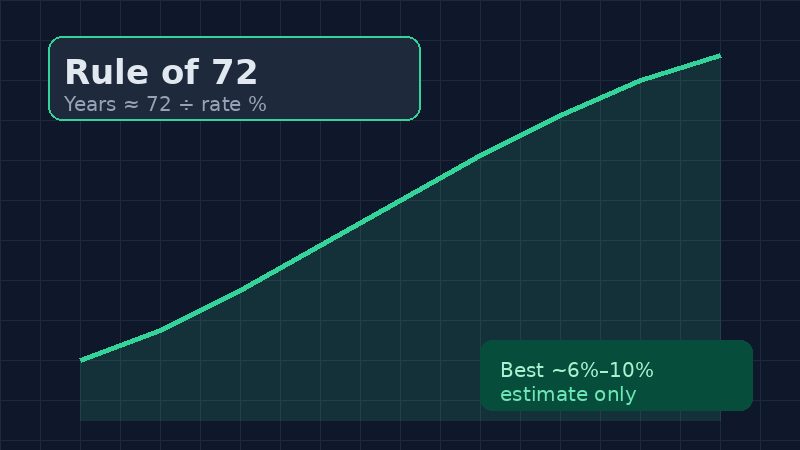
The Rule of 72 is a quick mental shortcut—divide 72 by an investment’s expected annual rate of return (as a percent) to estimate how many years it may take to double—but it is only an approximation, not an exact compound-interest calculation.
CNBC Select notes that the formula’s years are approximate and that it mainly works well for common rates of return in about the 5% to 12% range, with accuracy centered near an 8% return. Outside that band, adjusted numerators such as 71, 73, or 74 can track better.
Source: Rule Of 72: What It Is And How To Calculate It — CNBC Select