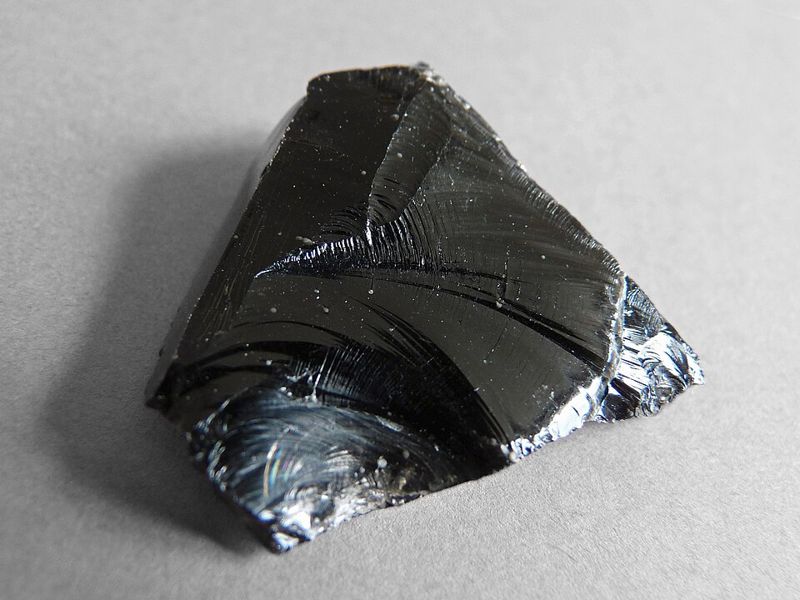
Igneous rocks form when molten rock cools and solidifies. Magma that cools slowly underground makes intrusive (plutonic) rocks such as granite, with large visible crystals, while lava that cools quickly at the surface makes extrusive (volcanic) rocks such as basalt or glassy obsidian, with tiny crystals or none.
Geologists classify igneous rocks mainly by texture (crystal size, which reflects cooling rate) and by mineral and chemical composition, especially silica content, which runs from felsic (silica-rich, like granite and rhyolite) through intermediate (diorite, andesite) to mafic and ultramafic (gabbro, basalt, peridotite).
Source: Igneous rock, Wikipedia
Image: Obsidian from Lipari by Ji-Elle, CC BY-SA 3.0, via Wikimedia Commons.