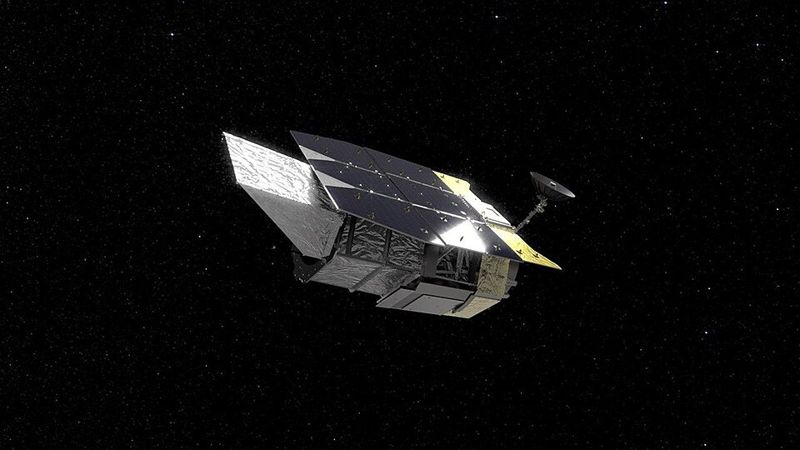
Sharper than planned. After engineers finished checking and aligning NASA’s Nancy Grace Roman Space Telescope, which launched on August 30, 2026, its main camera, the Wide Field Instrument, measured an optical error of about 63 nanometers RMS (root mean square, a measure of how far incoming light strays from a perfectly focused wavefront). The pre-launch requirement was about 90 nanometers RMS, so image quality came out nearly 30% better than predicted.
Only tiny corrections were needed: the team moved the secondary mirror by about one-sixteenth of the width of a human hair. Roman’s Coronagraph Instrument, which had been slightly out of focus, was also corrected and now meets its performance targets, with tests of its ability to block starlight planned in the coming weeks. NASA says this sets up Roman’s wide sky surveys for its studies of dark matter and dark energy.
Image: Illustration of the Nancy Grace Roman Space Telescope. NASA; public domain via Wikimedia Commons.