
Last updated: November 4, 2026
Here is how to check tire pressure: when the tires are cold, remove the valve cap, press a tire pressure gauge firmly onto the valve stem and read the PSI. Compare it with the pressure on the label inside the driver’s door, then add or release air until every tire matches.
Contents
- How to check tire pressure step by step
- What should my tire pressure be?
- How often should you check tire pressure?
- Tire pressure in cold weather
- What the tire pressure light means
- Why correct tire pressure matters
- Frequently asked questions
How to check tire pressure step by step
You need a tire pressure gauge and, if any tire is low, an air pump or a service station air machine. These steps follow the tire pressure guidance from the National Highway Traffic Safety Administration (NHTSA):
- Find your recommended pressure. Look on the Tire and Loading Information Label on the driver’s side door edge or door post, or in the owner’s manual. It lists the correct cold pressure in PSI (pounds per square inch) and kPa (kilopascals).
- Make sure the tires are cold. The car should not have been driven for at least three hours.
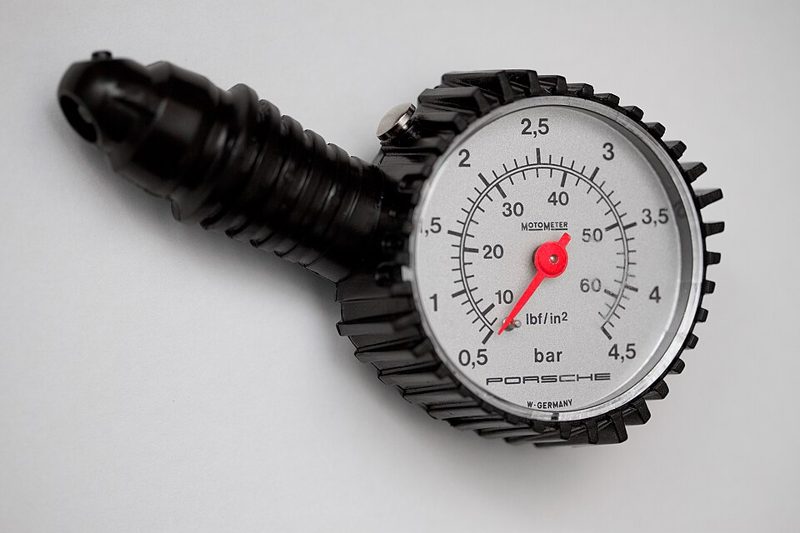
- Remove the valve cap and press the gauge onto the valve stem. Push it straight on and read the number.
- Release air if the pressure is too high. Gently press the valve stem with the edge of the gauge, then measure again.
- Add air if the pressure is too low. Note how many PSI are missing, add that much air, and recheck with the gauge.
- Repeat for every tire, including the spare, and put the valve caps back on. All tires should match unless the label lists different front and rear pressures.
What if the tires are already warm?
NHTSA says that if you have been driving and think a tire is low, you can fill it to the recommended cold pressure. The tire may still be slightly underinflated because warm air reads higher, but that is safer than driving on a significantly underinflated tire. Recheck once the tires are cold.
What should my tire pressure be?
The correct pressure is the one your vehicle manufacturer lists, not the number on the tire. Bridgestone explains that the figure molded on the sidewall is the tire’s maximum inflation pressure, and keeping tires at the maximum can make them wear faster or reduce traction and braking. FuelEconomy.gov gives the same warning.
| Where to look | What it tells you |
|---|---|
| Label on the driver’s door edge or door post (B-pillar) | Recommended cold pressure for front, rear and spare tires, plus tire size |
| Owner’s manual | The same recommended pressures, and any changes for heavy loads |
| Tire sidewall | Maximum pressure the tire can hold, not the pressure to use |
If your vehicle has no B-pillar, NHTSA says the label may be on the rear edge of the driver’s door or on a surface next to the driver’s seat.
How often should you check tire pressure?
Check at least once a month. Bridgestone notes that tires lose about 1 PSI of pressure per month on average, so even a tire with no leak drifts low over time. The U.S. Tire Manufacturers Association (USTMA) also recommends a check:
- Before a long trip
- Before carrying a heavy load
- Before towing a trailer
- After hitting a pothole or curb, which NHTSA says can cause a sudden loss of pressure
Keep a gauge in the car so you can check anywhere. While you are at each tire, check the tread as well: NHTSA says tires should be replaced at 2/32 of an inch, and with a penny placed head down in the tread, seeing the top of Lincoln’s head means it is time for new tires.
Tire pressure in cold weather
Air contracts as it cools, so tire pressure falls in winter. Michelin says tires lose about 1 PSI for every 10°F drop in temperature, and USTMA gives a range of 1 to 2 PSI per 10 degrees. A 30°F overnight drop can therefore leave a tire 3 to 6 PSI low. For temperature conversions, see how to convert Celsius to Fahrenheit.
Michelin warns that low pressure in winter reduces traction, lengthens stopping distances and causes uneven wear. Do not overinflate to compensate either, because too much air shrinks the contact patch and reduces grip on ice. Set the pressure to the label value when the tires are cold.
Cold snaps strain other parts of the car too. If the battery dies on a frozen morning, follow our guide on how to jump start a car safely, and at home, see how to prevent frozen pipes.
What the tire pressure light means
Passenger cars, light trucks and vans from model year 2008 and newer must have a tire pressure monitoring system (TPMS), according to NHTSA. The warning symbol is either a tire cross-section with an exclamation mark or a top view of a car showing all four tires.
| What you see | What it means | What to do |
|---|---|---|
| Light stays on | At least one tire is significantly underinflated | Check all tires with a gauge as soon as possible and add air |
| Light comes on during cold mornings, then goes off | Pressure is marginally low and dips below the warning level overnight | Check and top up all tires when cold |
| Light flashes for 60 to 90 seconds, then stays on | The TPMS has a malfunction | Have a dealer inspect the system |
A TPMS is not a substitute for a gauge. USTMA says these systems warn when a tire is about 25% underinflated, which for many vehicles may be too late to prevent damage.
Why correct tire pressure matters
NHTSA calls proper tire pressure the most important part of tire maintenance because it affects safety, tire life and fuel use. According to NHTSA, 511 people died in tire-related crashes in 2024, and properly inflated tires can extend the average life of a tire by 4,700 miles.
- Safety: USTMA says underinflated tires build up excessive heat and internal damage, while overinflated tires are more easily cut or damaged by potholes.
- Fuel: FuelEconomy.gov says correct inflation improves gas mileage by 0.6% on average and up to 3% in some cases, and mileage drops about 0.2% for every 1 PSI drop in average pressure.
- Tire life: Low pressure causes irregular and premature tread wear.
Better mileage also means lower emissions; see how a carbon footprint is calculated.
Frequently asked questions
How often should you check tire pressure?
Check the pressure in all four tires and the spare at least once a month, according to NHTSA. Also check before a long trip, when carrying a heavy load or towing a trailer, and after a hard hit on a pothole or curb.
What should my tire pressure be?
Use the cold inflation pressure on the Tire and Loading Information Label on the driver’s side door edge or door post, or in your owner’s manual. Do not use the number printed on the tire sidewall, which is the tire’s maximum pressure.
Should tire pressure be checked hot or cold?
Check tire pressure when the tires are cold, meaning the car has not been driven for at least three hours. Pressure rises as tires warm up while driving, so a hot reading looks higher than the true cold pressure.
Does cold weather affect tire pressure?
Yes. Tire pressure drops about 1 PSI for every 10°F drop in temperature, according to Michelin, and the U.S. Tire Manufacturers Association puts the change at 1 to 2 PSI per 10 degrees. A tire set correctly in September can be several PSI low by December.
Why is my tire pressure light on?
A steady tire pressure light means at least one tire is significantly underinflated, so check all tires with a gauge as soon as possible. If the light flashes for 60 to 90 seconds at start-up and then stays on, the monitoring system itself has a fault and needs a dealer inspection.
Can you tell tire pressure by looking at the tire?
No. NHTSA says underinflated tires are visually difficult to detect, which is why it recommends a monthly check with an accurate gauge. Bridgestone-owned tire stores also offer free pressure checks.
Sources
- NHTSA: Tire Safety (TireWise)
- U.S. Tire Manufacturers Association: Tire Care Essentials
- FuelEconomy.gov: Keeping Your Vehicle in Shape
- Bridgestone Americas: Proper Tire Inflation
- Michelin USA: How Cold Weather Affects Tire Pressure
Image: “Porsche Tire Pressure Gauge” by Antti, licensed under CC BY 2.0, resized, via Wikimedia Commons.
