
Last updated: November 10, 2026
To play chess, set up the board with a light square in each player’s right-hand corner, then take turns moving one piece at a time, with White moving first. Each piece moves in its own pattern. You win by checkmating the opposing king: attacking it so it has no legal way to escape.
This guide explains how to play chess using the official FIDE Laws of Chess, from setup to checkmate.
Contents
- How do you set up a chess board?
- How do the chess pieces move?
- Special moves: castling, promotion and en passant
- What is check and checkmate?
- How does a chess game end in a draw?
- How to play chess for beginners: basic strategy
- Frequently asked questions
How do you set up a chess board?
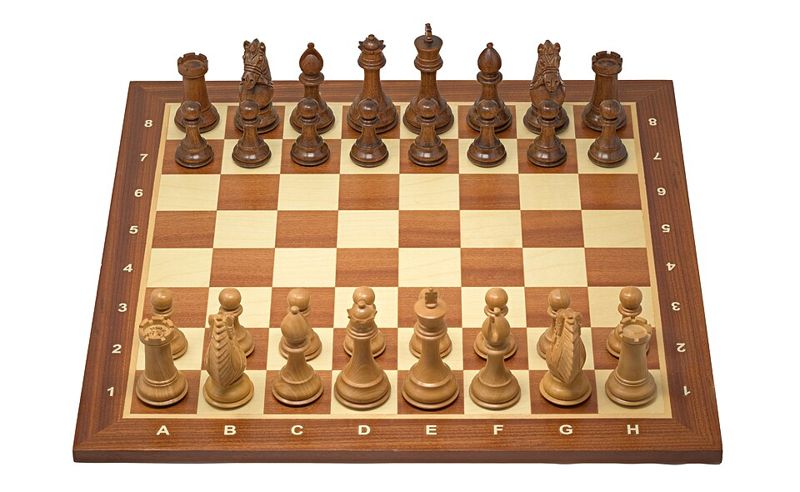
Chess is played by two players on an 8 x 8 board of 64 squares. Place the board so the near corner square on each player’s right is light. Each side starts with 16 pieces: one king, one queen, two rooks, two bishops, two knights and eight pawns (FIDE Laws of Chess). For a closer look at the board itself, see how many squares are on a chessboard.
- Place White’s eight pawns on the second row (rank 2) and Black’s on rank 7.
- Put the rooks in the four corners.
- Put the knights next to the rooks, then the bishops next to the knights.
- Put each queen on a square of her own color: the white queen on a light square, the black queen on a dark square.
- Put each king on the remaining square beside its queen.
Chess.com sums up the queen rule simply: the queen always goes on her own matching color (Chess.com).
How do the chess pieces move?
No piece may move onto a square occupied by one of its own pieces. Moving onto a square held by an opponent’s piece captures it, and that piece leaves the board. The bishop, rook and queen cannot jump over other pieces (FIDE); only the knight can (Chess.com).
| Piece | How it moves | Common point value |
|---|---|---|
| King (K) | One square in any direction | Not counted (losing it loses the game) |
| Queen (Q) | Any number of squares along a rank, file or diagonal | 9 |
| Rook (R) | Any number of squares along a rank or file | 5 |
| Bishop (B) | Any number of squares diagonally | 3 |
| Knight (N) | In an L shape: two squares one way, then one square at a right angle; it can jump over pieces | 3 |
| Pawn | One square forward, or two on its first move; captures one square diagonally forward | 1 |
The point values are a common guide for deciding whether a trade is worth it, not an official rule; they do not count toward the result (Chess.com). Each bishop stays on the color it starts on for the entire game.
How pawns move and capture
Pawns are the only pieces that move one way and capture another. A pawn moves straight ahead only if the square in front is empty, and it captures diagonally forward on an adjacent file (FIDE).
Special moves: castling, promotion and en passant
Castling
Castling is a single move of the king and a rook. The king moves two squares toward the rook, and that rook moves to the square the king just crossed. FIDE rules say you cannot castle if:
- the king has already moved, or the rook you want to use has already moved;
- the king is in check, or would pass through or land on a square attacked by an enemy piece;
- any piece stands between the king and the rook.
Castling toward the king’s side is called kingside castling, and toward the queen’s side is queenside castling (FIDE; Chess.com).
Pawn promotion
When a pawn reaches the far rank, it must be exchanged, as part of the same move, for a queen, rook, bishop or knight of the same color. Your choice is not limited to pieces that were captured earlier (FIDE).
En passant
If a pawn advances two squares and lands beside an enemy pawn, that enemy pawn may capture it as if it had moved only one square. This capture is legal only on the very next move (FIDE). Our short answers explain what en passant is in chess and whether en passant is mandatory.
What is check and checkmate?
A king is in check when an enemy piece attacks it. You may never make a move that leaves or puts your own king in check (FIDE). There are three ways to get out of check (Chess.com):
- Move the king to a safe square (castling does not count).
- Block the attack by placing a piece in between.
- Capture the attacking piece.
If none of these works, it is checkmate and the game is over. A player can also end the game by resigning (FIDE).
How does a chess game end in a draw?
The FIDE Laws list these ways a game is drawn (FIDE):
- Stalemate: the player to move has no legal move and is not in check.
- Dead position: neither player can checkmate by any series of legal moves, such as king and bishop against king (Chess.com).
- Agreement: both players agree to a draw after each has made at least one move.
- Threefold repetition: the same position occurs for at least the third time, and the player to move claims it.
- 50-move rule: each player has made 50 moves with no pawn move and no capture, and the player to move claims it.
Automatic draws most guides leave out
Repetition and the 50-move rule normally require a claim. Under FIDE rules, however, the game is drawn automatically if the same position appears at least five times, or if each player makes at least 75 moves with no pawn move and no capture. If the last move gave checkmate, the checkmate takes precedence (FIDE).
How to play chess for beginners: basic strategy
Chess.com recommends a few habits for new players (Chess.com):
- Control the center. Pawns and pieces in the middle of the board give you more room to move.
- Develop all your pieces. Bring knights and bishops off the back row instead of moving one piece repeatedly.
- Castle early to move your king to safety.
- Do not give pieces away. Before each move, check what your opponent can capture.
- Play many games. Practice is the most important way to improve.
In tournaments, the touch-move rule applies: if you deliberately touch one of your pieces, you must move it if it can legally move (FIDE). If you also play checkers, see the difference between chess and checkers.
Frequently asked questions
Who moves first in chess?
White always moves first. After that, the players take turns, one move at a time, until the game ends.
Can a pawn move backwards?
No. A pawn can only move forward, and it captures one square diagonally forward. It can never move or capture backward.
Can you castle out of check?
No. You cannot castle while your king is in check, and the king also cannot pass through or land on a square that an enemy piece attacks.
Can you castle after being in check?
Yes. Being checked earlier does not remove the right to castle. You lose that right only if the king, or the rook you want to castle with, has already moved.
Can a pawn become a queen?
Yes. A pawn that reaches the far side of the board must be promoted to a queen, rook, bishop or knight of the same color. You may choose a queen even if your original queen is still on the board.
What is the 50-move rule in chess?
If each player has made 50 moves in a row with no pawn move and no capture, the player to move can claim a draw. Under FIDE rules, the game is drawn automatically after 75 such moves.
Sources
- FIDE Handbook: FIDE Laws of Chess (taking effect from 1 January 2023)
- Chess.com: How to Play Chess, Rules and 7 Steps to Get You Started
Featured image: Staunton chess set in the starting position. Photo by Wilfredor, released under CC0, via Wikimedia Commons.
