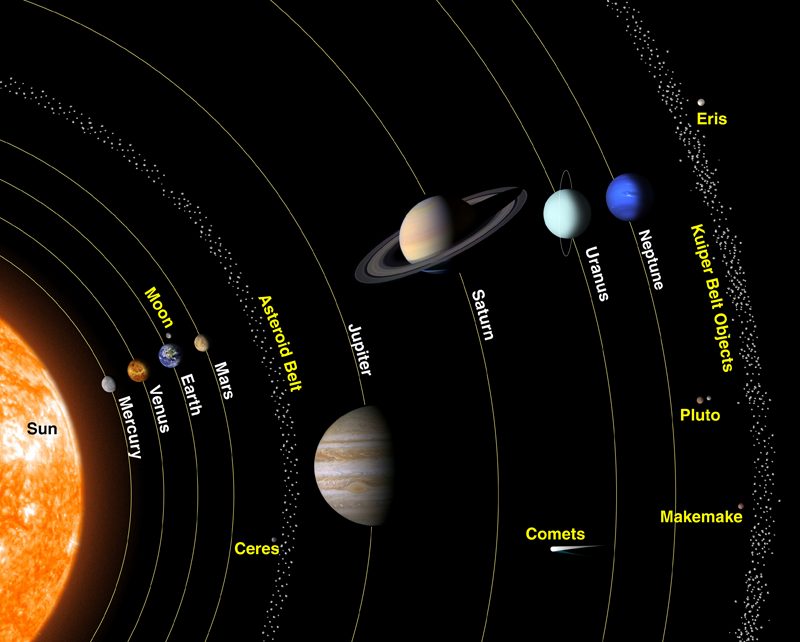
Celestial bodies are the natural objects in space that astronomers study, such as stars, planets, dwarf planets, moons, asteroids, and comets. The Sun is a star, Earth is a planet, the Moon is Earth’s natural satellite, and comets are small icy bodies that can grow glowing tails when they pass near the Sun.
According to the International Astronomical Union’s Office of Astronomy for Education, the terms celestial body, celestial object, astronomical body, and astronomical object are used almost interchangeably for physical things in space, including galaxies and gas clouds. In a narrower sense, some astronomers reserve “celestial body” for objects clearly separated from their surroundings, so a planet counts as a celestial body while a gas cloud is called an astronomical object instead.
Source: IAU Office of Astronomy for Education, Glossary term: Celestial Body
Image: Solar System graphic by NASA, public domain, via Wikimedia Commons.