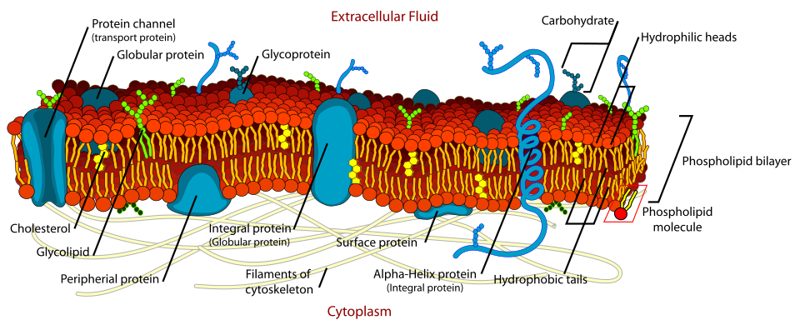
Glycosylated proteins, usually called glycoproteins, are proteins that have carbohydrate (sugar) chains attached to them. The process of adding those sugar chains is called glycosylation, and it happens as newly made proteins pass through the endoplasmic reticulum and the Golgi apparatus inside the cell.
Many glycoproteins sit in the cell’s outer membrane with their sugar chains facing outward. OpenStax Biology notes that these chains can contain 2 to 60 sugar units, may be straight or branched, and together with sugars on membrane lipids form the glycocalyx, a sugar coating that helps cells recognize one another. The immune system relies on these surface markers, and some viruses use them to get in: HIV, for example, binds to CD4, a glycoprotein on T cells.
Source: OpenStax Biology 2e, 5.1 Components and Structure
Image: cell membrane diagram by Mariana Ruiz (LadyofHats), public domain, via Wikimedia Commons.