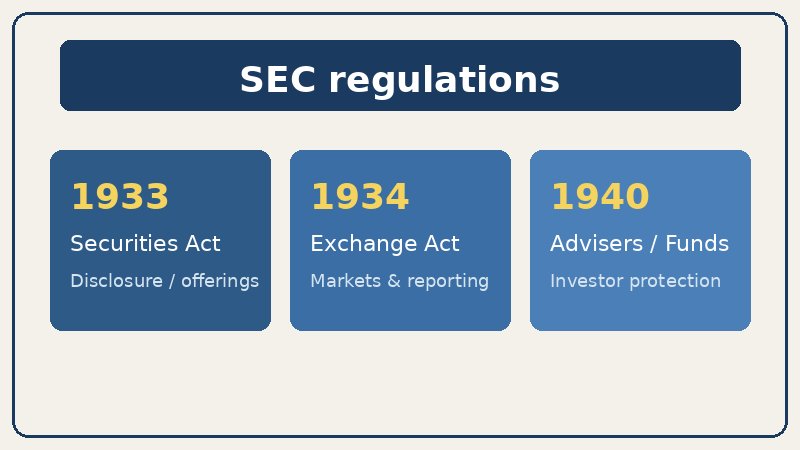
U.S. securities regulation rests on major federal statutes the Securities and Exchange Commission administers. Landmark examples include the Securities Act of 1933 (often called the “truth in securities” law), which requires disclosure for public offerings and bars fraud in the sale of securities, and the Securities Exchange Act of 1934, which created the SEC and governs exchanges, brokers, periodic reporting by public companies, and related market conduct.
Other core laws include the Investment Company Act of 1940 (mutual funds and similar pooled vehicles), the Investment Advisers Act of 1940 (registration and conduct of advisers), plus later reforms such as Sarbanes-Oxley (2002), Dodd-Frank (2010), and the JOBS Act (2012). The SEC also issues detailed rules under these statutes; Investor.gov summarizes the main laws that govern the securities industry.