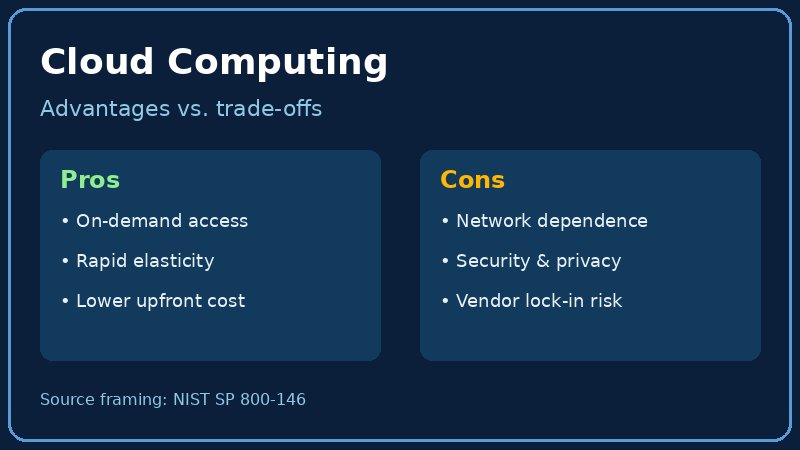
Cloud computing lets organizations rent on-demand access to shared computing resources—servers, storage, networks, and applications—instead of buying and running all of that hardware themselves. According to NIST’s cloud synopsis (SP 800-146), major advantages include lower up-front capital costs, rapid elasticity (scale up or down as needed), and faster deployment for pilots and new services.
Trade-offs matter too. Cloud services depend on networks, so outages, latency, and data-transfer limits can hurt availability. Organizations also take on security and privacy responsibilities in multi-tenant environments, reduced direct control over infrastructure, compliance obligations, and risks such as vendor lock-in or migration costs. Whether cloud is cheaper overall depends on a full look at operations, security, and exit costs—not only the monthly bill.
Source: NIST SP 800-146 — Cloud Computing Synopsis and Recommendations