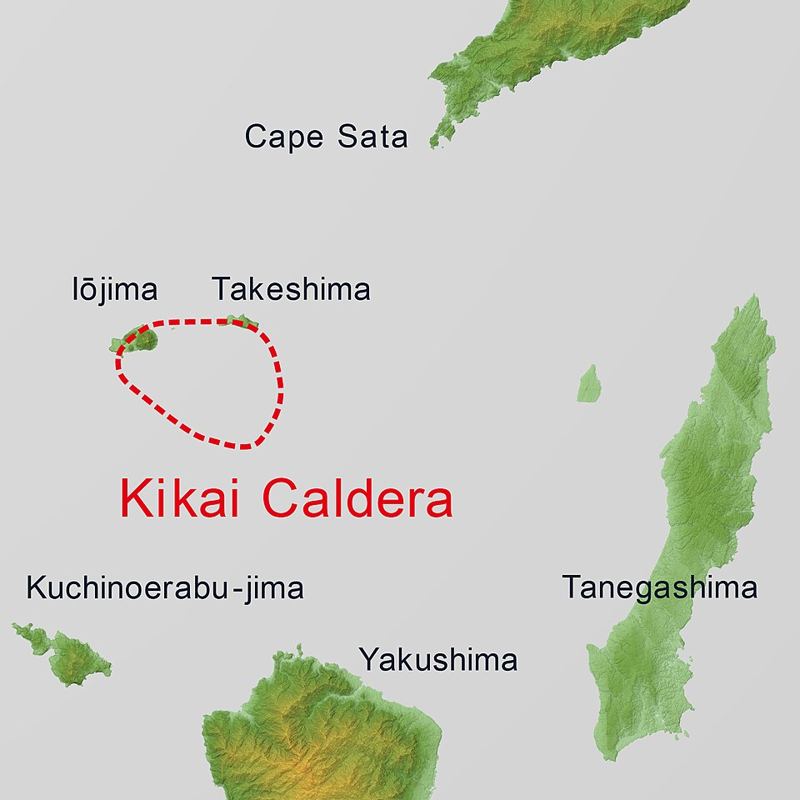
The Kikai-Akahoya eruption, which burst from the seabed south of Kyushu about 7,300 years ago, did not simply wipe out Japan’s Jomon hunter-gatherers or leave them unaffected. A Lund University-led study published in Science Advances in October 2026 found a mixed outcome: the eruption caused major loss of life, ecosystem damage and uninhabitable areas, but survivors migrated, formed new social ties and developed new ways of living, and some populations even grew afterward.
The researchers report that southern Kyushu’s population was already shrinking before the eruption, while northern Kyushu kept growing through and after it, possibly helped by people fleeing worse-hit areas and moving toward the coast, where marine food sources recovered fairly quickly. In regions farther from the volcano, population growth that had been under way before the eruption stalled or reversed afterward.
Image: Relief map of the Kikai Caldera south of Kyushu, by Batholith, public domain, via Wikimedia Commons.