
Last updated: November 24, 2026
What is Advent? Advent is the Christian season of waiting and preparation before Christmas. It begins on the fourth Sunday before Christmas and ends on Christmas Eve. In 2026, Advent starts on Sunday, November 29, and many households mark each week by lighting one more candle on an Advent wreath.
This guide explains what Advent means, when it starts each year, what the wreath and candle colors stand for, how Advent calendars work and how different churches observe the season.
Contents
- What is Advent and what does it celebrate?
- When does Advent start and end?
- What is an Advent wreath?
- Advent candles: meaning, colors and order
- What is an Advent calendar?
- How is Advent observed?
- Frequently asked questions
What is Advent and what does it celebrate?
Advent is a season observed in most Christian denominations as a time of waiting and preparation, according to Wikipedia’s article on Advent. It looks ahead to two events: the celebration of Jesus’s birth at Christmas and his return at the Second Coming.
The United States Conference of Catholic Bishops (USCCB) describes this as Advent’s twofold character. It is a time of “devout and expectant delight,” with an element of penance in the sense of quieting and preparing the heart for Christmas.
What does the word Advent mean?
The name comes from the Latin adventus, meaning “coming” or “arrival.” The USCCB traces it to ad-venire, “to come to.” In Western churches, the first day of Advent also starts a new liturgical, or church, year.
When does Advent start and end?
In the Catholic, Anglican, Lutheran, Presbyterian and Methodist calendars, Advent begins on the fourth Sunday before Christmas. That is the Sunday falling on or closest to November 30, so it is always between November 27 and December 3. Advent ends on Christmas Eve, December 24.
Because the start date moves, the season lasts 22 to 28 days. The table below applies that rule to the next five years.
| Year | First Sunday of Advent | Fourth Sunday of Advent | Length of Advent |
|---|---|---|---|
| 2026 | November 29 | December 20 | 26 days |
| 2027 | November 28 | December 19 | 27 days |
| 2028 | December 3 | December 24 | 22 days |
| 2029 | December 2 | December 23 | 23 days |
| 2030 | December 1 | December 22 | 24 days |
Advent 2026 dates
The USCCB lists Advent 2026 as running from Sunday, November 29, through Thursday, December 24. The Sundays fall on November 29, December 6, December 13 (Gaudete Sunday) and December 20. The season ends a few days after the winter solstice.
Does every church start Advent on the same day?
No. The Ambrosian and Mozarabic rites of the Catholic Church begin Advent on the sixth Sunday before Christmas, in mid-November. Eastern Orthodox churches keep a related but different season, the Nativity Fast, which differs in meaning, length and observances, according to Wikipedia. An Orthodox source cited by Wikipedia’s Advent wreath article describes a 40-day period beginning November 15.
What is an Advent wreath?
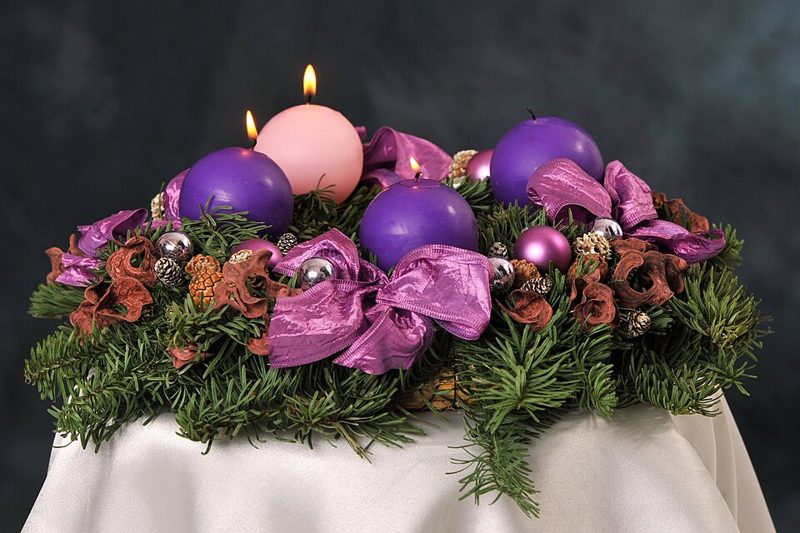
An Advent wreath is a circle of evergreen branches holding four candles, one for each Sunday of Advent. The USCCB says the progressive lighting of the candles stands for the hope surrounding Christ’s first coming and the anticipation of his second. Catholic Relief Services adds that the circular shape represents God’s eternal love.
The custom began among German Lutherans. Wikipedia credits Johann Hinrich Wichern, a Lutheran pastor in Hamburg, with the modern wreath. In 1839, he decorated a wooden cartwheel with 24 small red candles for weekdays and four large white candles for Sundays. The idea later shrank to today’s four- or five-candle wreath, spread to German Catholics in the 1920s and reached North America in the 1930s.
Advent candles: meaning, colors and order
One new candle is lit each Sunday, and earlier candles are lit again, so all four burn by the fourth Sunday. Here is the common order used with three purple candles and one rose candle:
- First Sunday (November 29, 2026): light the first purple candle.
- Second Sunday (December 6, 2026): light the second purple candle, plus the first.
- Third Sunday (December 13, 2026): light the rose candle, plus the two purple candles.
- Fourth Sunday (December 20, 2026): light the last purple candle, so all four are lit.
- Christmas Eve or Christmas Day: if the wreath has a white center candle, light it.
What do the Advent candle colors mean?
- Purple (violet): the USCCB says the purple candles stand for prayer, penance, preparatory sacrifices and good works. Violet has been the usual Advent color in Western churches since about the 13th century.
- Rose (pink): lit on the third Sunday, Gaudete Sunday, a Sunday of rejoicing that marks the midpoint of Advent.
- Blue: some churches use blue instead of violet to stress hope, according to Wikipedia.
- Red: many Protestant churches, especially in the United Kingdom, use four red candles.
- White: an optional center “Christ candle,” white because it is the festive color of the Western church.
The USCCB notes that white candles can also be used for the whole wreath. Many families name the candles Hope, Peace, Joy and Love, but these names and their order vary by church and are a custom rather than a fixed rule.
What is an Advent calendar?
An Advent calendar counts down the days to Christmas. The name comes from the German Adventskalender, and the calendar was first used by German Lutherans in the 19th and 20th centuries, according to Wikipedia’s Advent calendar article.
Most calendars have one door or flap for each day. Behind each door is a picture, a Bible verse, a prayer, a piece of a story or a small gift such as a chocolate. Since the first Sunday of Advent falls between November 27 and December 3, many reusable calendars simply start on December 1 and run to December 24 or 25. The USCCB also publishes a free printable Advent calendar each year with daily prayer and activity ideas.
How is Advent observed?
Practices differ by church and household. Common ones described by Wikipedia and the USCCB include:
- Lighting the Advent wreath each Sunday, often with a Bible reading and prayer.
- Opening an Advent calendar door each day.
- Following a daily devotional or reading plan.
- Seeing violet vestments and simpler altar decoration at church, with rose on Gaudete Sunday.
- Singing the “O” Antiphons from December 17 to 24, a custom dating to at least the eighth century.
- Preparing the home for Christmas, such as setting up a tree and lights.
For the decorating side of the season, see our guides on how to keep a Christmas tree alive and how to hang Christmas lights safely. After Advent ends, the Christmas season begins; read about Boxing Day on December 26 and Kwanzaa, which also starts that day.
Frequently asked questions
When does Advent start in 2026?
Advent 2026 begins on Sunday, November 29, 2026, and ends on Thursday, December 24, 2026, Christmas Eve. The four Sundays of Advent fall on November 29, December 6, December 13 and December 20.
How long is Advent?
In Western churches, Advent lasts from the fourth Sunday before Christmas to Christmas Eve, so it runs 22 to 28 days depending on the year. In 2026 it lasts 26 days.
What do the 4 candles of Advent mean?
The four candles stand for the four Sundays of Advent, and one more is lit each week. Many churches and families link them to hope, peace, joy and love, though the names vary by tradition.
Why is one Advent candle pink?
The pink, or rose, candle is lit on the third Sunday of Advent, called Gaudete Sunday. Gaudete is Latin for rejoice, and the rose color marks joy that Christmas is near.
What does the word Advent mean?
Advent comes from the Latin adventus, meaning coming or arrival. The USCCB traces it to the Latin ad-venire, to come to.
Do Advent calendars start on December 1?
Many do. Because the first Sunday of Advent moves each year, most reusable Advent calendars begin on December 1 and count down to December 24 or 25, while others begin on the first Sunday of Advent.
Sources
- USCCB: What is Advent?
- Wikipedia: Advent
- Wikipedia: Advent wreath
- Wikipedia: Advent calendar
- Catholic Relief Services: Advent wreath