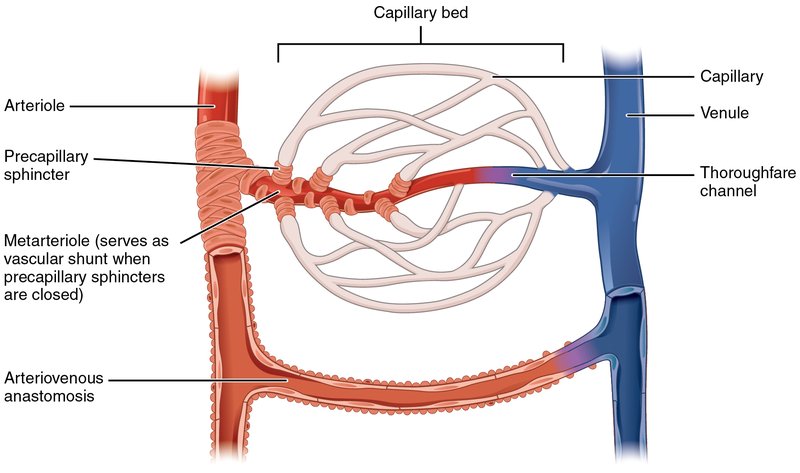
Capillary no-reflow is when the tiniest blood vessels (capillaries) stay blocked even after a larger artery that was clogged—for example in a heart attack or acute kidney injury—has been reopened. Tissue still does not get fresh blood, which is linked to higher death and reinfarction risk, and until recently there was no targeted therapy for it.
A study published in Nature on October 14, 2026, reports that the blockage is driven by over-contraction of pericytes (cells wrapped around capillaries) through smooth-muscle myosin. The researchers developed R(+)2501, a capillary-selective myosin inhibitor. In animal models of heart attack and acute kidney injury, it quickly restored capillary flow, cleared trapped neutrophils, preserved broader blood-pressure control, and improved survival during acute reperfusion. The work also suggests heart-attack–triggered capillary no-reflow in the kidney may help explain type I cardiorenal syndrome.
Image: Capillary bed diagram from OpenStax College, CC BY 3.0, via Wikimedia Commons.