
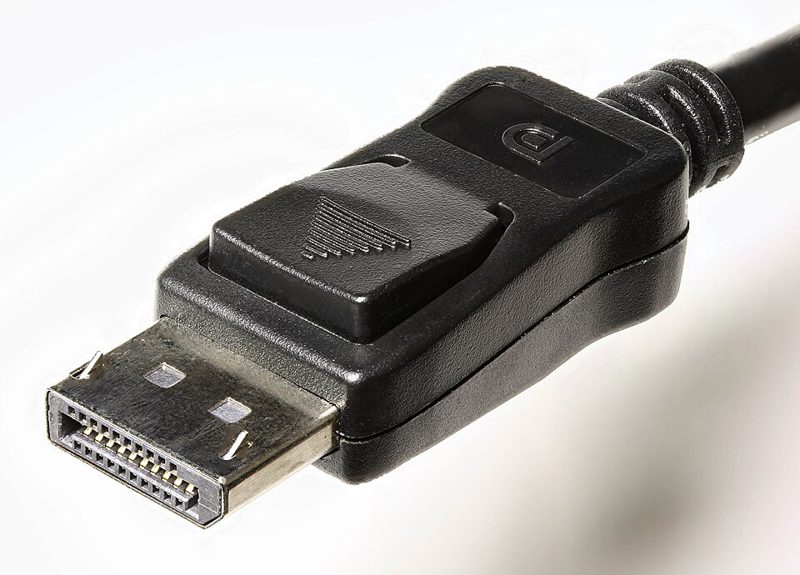
Multi-Stream Transport (MST) is a DisplayPort feature, introduced in DisplayPort 1.2, that lets a single DisplayPort output on a computer drive several independent monitors.
It works by multiplexing several video streams into one signal and sending it to a branch device, which splits it back into the original streams. That branch device is usually an MST hub with multiple outputs, or a monitor with a DisplayPort output port that lets you daisy-chain the next screen. In theory MST supports up to 63 displays, but all of them together cannot exceed the bandwidth of one port: 17.28 Gbit/s for DisplayPort 1.2 or 25.92 Gbit/s for 1.3 and 1.4. A daisy chain can be at most 7 links long, and a hub can have at most 7 outputs. With DisplayPort 1.3, one port can run two 4K monitors at 60 Hz or four 2560×1600 monitors at 60 Hz. Each monitor in a chain except the last needs MST support and a DisplayPort output, and the computer’s software must support MST too. Windows does, while macOS did not support MST hubs or daisy chaining as of macOS 10.15 Catalina. MST also works over USB-C DisplayPort Alternate Mode. Ordinary one-monitor operation is called Single-Stream Transport (SST).
Source: Wikipedia, DisplayPort: Multi-Stream Transport
Image: DisplayPort connector by D-Kuru, CC BY-SA 3.0 AT, via Wikimedia Commons.