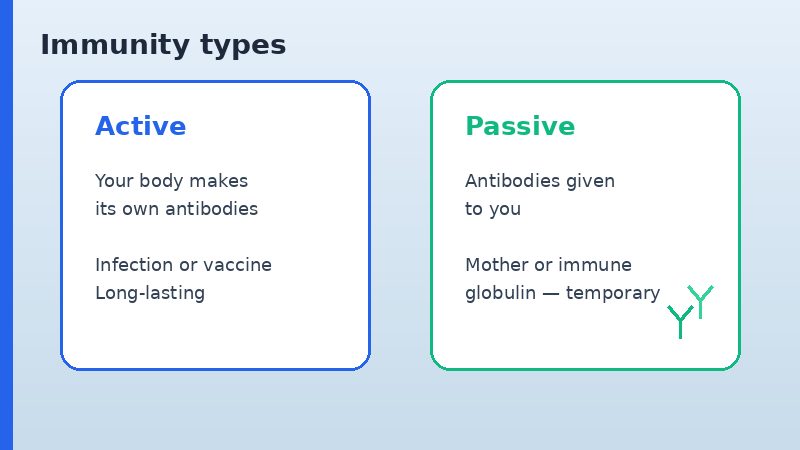
Passive immunity is protection that comes from receiving ready-made antibodies rather than making them yourself. According to the U.S. Centers for Disease Control and Prevention (CDC), a person gets passive immunity when antibodies produced by another person (or sometimes an animal product) are transferred into their system.
The most common example is a newborn: antibodies pass from mother to baby across the placenta, especially late in pregnancy. People can also receive passive immunity from antibody-containing blood products such as immune globulin when clinicians need rapid protection against a specific disease.
The main advantage is speed—protection starts right away—while active immunity (from infection or vaccination) usually takes weeks to build. The trade-off is duration: passive immunity typically lasts only weeks to months, whereas active immunity is longer-lasting and sometimes lifelong.