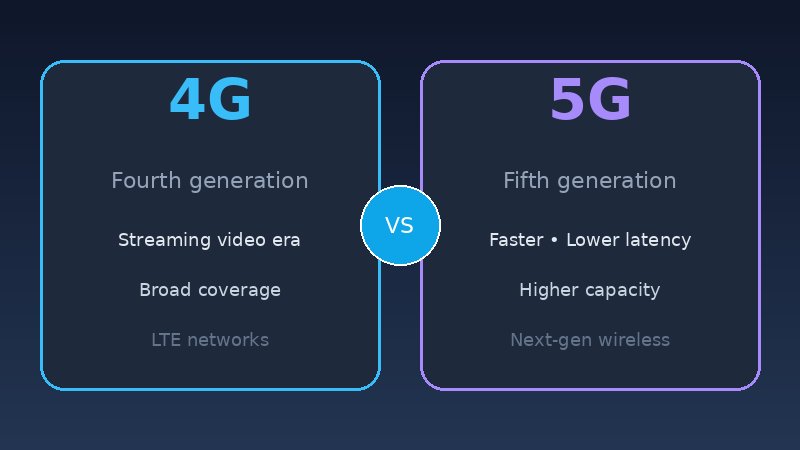
4G (fourth generation) is the cellular standard that enabled reliable mobile video streaming, gaming, and high-speed data on LTE networks. 5G is the fifth generation: it is designed for much higher peak data rates, lower latency (less delay), and greater network capacity so more devices can stay connected in crowded places.
According to the FCC, some 5G services can deliver data speeds up to about 100 times faster than 4G with near-instant response times—for example, a feature-length movie that might take several minutes to download on 4G could take on the order of seconds on a strong 5G connection. Real-world speeds still depend on coverage, spectrum band, congestion, and your device.
4G phones keep working where 5G is unavailable; 5G phones are typically backward compatible with earlier networks. Wi-Fi routers labeled “5G” usually mean the 5 GHz Wi-Fi band, not cellular 5G. Source: FCC 5G FAQs.